Generational Shifts and Choices of a Lifetime

Eight years later, the choice is similar but far clearer. However, the root problem is that we are not all seeing the same things. Maybe that’s always been true, but it’s more of an obstacle now that we seem to lack shared reference points. So how does one proceed from here? Well, increasingly with every season of my life, I see the influences and effects of what I might call the generational lens. Now, when I think about people, culture, politics, religion, or sports, I am more aware than ever of being a man born in the early 1970s. This framing of my perceptions is not necessarily negative, and it has in fact helped me to make more sense of one of the more stressful decades of politics I’ve ever witnessed. Even so, the journey of reflecting on these times and this decision before the nation has been frustrating beyond words.

I came of age during the Ronald Reagan presidency with three parents that were in a relative spectrum of center to left and a grandfather who was prone to approvingly refer to Reagan’s reputation as the ‘Great Communicator.’ The twenty years and five presidential terms from roughly 1981 through 2001 created a sense for much of my own Generation X—and for many members of the Baby Boom generation as well—that although there was inarguably prejudice and inequity that still required attention and effort in American society, there was a prominent feeling of overall stability and gradual improvement. Looking back on those politics through the combination of both personal recall and my education, I can assemble the general sense that the country had moved on from the unrest of the 1960s and the rabble-rousing and vociferous left-wing protests of the 1970s as well as the economic problems of that latter decade. People expected life to offer increasingly more conveniences and opportunities, and after the fall of the Berlin Wall in 1989 and the collapse of the Soviet Union, the feeling of national tension related to past or future wars seemed to dissolve in an uplifting new zeitgeist.

This description is of course a superficial construction of things as they actually were because during the 1980s, sexism, racism, and other forms of bias were jarringly present much of the time, and in the 90s, the LA riots in the aftermath of the Rodney King beating and the social recoil of the O.J. Simpson verdict both revealed the mismatch between notions of relative harmony and lived experiences. It must also be said that the 1980s were a key inflection point in decades of failed controlled substance policies championed by both Democrats and Republicans. However, in comparison to prior decades, 1981 to early 2001 was a remarkable period of optimism, particularly in the final five years of this timeframe, in which crime and murder rates notably went down while the access to exploration and commerce available through the internet became the focus of society’s attention and enthusiasm. 

During these two decades, we certainly saw our share of dissenters. Perhaps the most prominent whom I can remember was independent presidential candidate H. Ross Perot, who mounted a historic campaign against George H.W. Bush and Bill Clinton for the 1992 presidential election. Perot used a populist approach to preaching for fiscal practicality and government reform. He may have even had a chance to win the election had he not decided that his campaign was actually working too well. Even after the strange two-step of withdrawing and then re-entering the race, he still garnered an unthinkable 18.9% of the national popular vote. Upon reflection, Perot was probably everything that Donald Trump never was in terms of qualifications and success as an entrepreneur and philanthropist.

I cite this specific period because beginning with the September 11th, 2001 attacks, the chaotic nature of events every few years in the 21st century thus far have created repeated openings for figures such as this version of Trump to take advantage of a sense of lost stability particularly among Generation X and Baby Boomers. Changes in racial demographics and gender roles also created the conditions for a candidate who might (falsely) promise to take this middle-aged and older group of voters back to so-called simpler times. The 2008 financial crisis resulted in a government rescue of big banks, and both the crisis and the bipartisan solution directly contributed to the next period of dissent in the form of first, the Tea Party movement and then in late 2011, the Occupy Wall Street demonstrations. Looking back on President Obama’s second term, it’s more possible now to understand some of the factors that gave an opening to the unusual candidacies of Bernie Sanders and Donald Trump.

In 2014, the Obama administration was unable to predict or respond effectively to Vladimir Putin’s invasion of Crimea. In addition, the terrorist organization ISIS repeatedly struck in murderous fashion in the Middle East, and the conflagration that they caused was followed by two more events that I believe helped to elect Donald Trump. The first of these was the San Bernardino, California terrorist attack in December of 2015 carried out by a married couple who were Muslim extremists partly inspired by ISIS. The other event was the similarly horrifying shooting attack at the Pulse nightclub in Orlando, Florida in June of 2016. These events absolutely contributed in those years to what I would consider the most upsetting social and geopolitical atmosphere since the 9-11 attacks themselves.

Despite the brighter moments of the Obama era such as the rescue of the automobile industry and the Obergefell decision legalizing gay marriage, there were still other ingredients that detracted from the Democratic Party’s effort to hold onto the White House in 2016, and one of these was what has been called the hidden recession of 2015-16. In those last two years of Obama’s presidency, industrial production, retail sales and global markets had substantial slowdowns or outright declines. Even though central banks acted to stabilize things and managed to avoid an official recession, businesses and some workers registered the effects. Lastly, for the first time in decades, there were increases in the rates of murder and crime overall in both 2015 and 2016.  

Donald Trump took advantage of the existing narratives around Hillary Clinton and the difficulty for either party to win three consecutive presidential elections by emphasizing the near-term troubles of 2014-2016. The actual accomplishments of Mr. Trump’s administration were very limited. What he described as tax reform was mainly a tax cut that went out of its way to remove local tax deductions that largely benefited people in blue states. He enacted inhumane policies at the border, and he increased the number of overseas drone strikes made by the military. As a nod to the far right, he made Jerusalem the new location of the United States Embassy in Israel. His administration built a fractional portion of a wall on the Southern border, but it was of course not financed by Mexico as promised. And then there were the tariffs.

During his term, Trump enthusiastically put into effect a series of tariffs of which he remains quite proud. This issue is particularly important in the current election campaign because he is promising a kind of Tariffs 2.0 policy. However, it is this policy that was on the merits by far one of his worst debacles while in office. The tariffs did have an effect, but it was not the one that was intended. Taxes on Chinese imports led to a trade war, and the loser was ultimately the American farmer. As farmers saw a substantial drop in their exports, their financial predicament became untenable. An existing trend in farmer suicides worsened under the Trump tariffs regime. The Trump administration’s solution was something that might ordinarily be called socialism. According to reporting in Forbes, Mr. Trump authorized more taxpayer funded cash subsidies to farmers than the federal government would spend in a calendar year on building ships for the Navy or maintaining America’s nuclear arsenal. A failed policy that results in more bankruptcies, deaths, and cash payouts from the government used to be exactly what conservatives and Republicans used to warn us about.

As I said at the outset, shared reference points are gone. Right wing media outlets and social media corporations have curated complete confusion about what does or does not constitute reliable information. Republican voters and state-level activists are living in a bizarre reality in which they insist that all of their congressional election outcomes are largely valid but that the election of Joe Biden in that same cycle has somehow been engineered by vote-switching mechanisms that do not exist. That’s because after Trump lost the majority of swing states in 2020, new realities had to be created out of whole cloth to feed the victimhood of Trump and his voters. There is a $787 million price tag on the harms done to truth and civic decency by Fox News Corporation after they were forced to settle in court at that figure for knowingly feeding people lies in their echo chamber about the Dominion corporation’s voting machines in the 2020 election. The even more pro-Trump outlets Newsmax and OANN have also had to settle similar suits for blatantly lying to their audiences in an effort to prop up Trump’s election lies.

The centrists and conservatives who have maintained a consistent point of view on things such as tariffs and opposition to authoritarian governments at home and abroad are now disparagingly called ‘RINOS’ (Republicans in name only) or worse, and so as a result, I’m in a strange coalition now that manages to include people such as Dick Cheney, Bill Krystol, and Mark Cuban along with Nancy Pelosi and Beyonce. Earlier this year, I read the book Romney: A Reckoning by McKay Coppins, and it made me think back to 2012. There was a specific moment in about August of that year when I said to Meredith that I was preparing for the possibility that Romney was going to win. What I also said was that on balance Romney and Ryan were a much better ticket than McCain and Palin overall in my view. If Romney was going to be president, I wouldn’t like it, but I could live with it. In the years since then and especially as demonstrated in Coppins’s work based on Romney’s personal journals and documents, it’s even clearer that Mitt was more correct about both Putin’s Russia and Donald Trump’s candidacy than I would have imagined.

This will be my ninth presidential election in which I’ll vote, and I’m extremely tired of the Trump phenomenon. I know that immigration is a genuine concern for some people, and I’m aware that despite the fact that the pandemic and Trump’s earlier tariffs have contributed to high prices, these issues stand out in people’s minds in relation to the current president and his party. However, almost all of these policy discussions are whistling past a future graveyard—of women. Donald Trump, a man who was a pro-choice Democrat into his mid-60’s, does not care about abortion except as a card that he was able to play via the appointment of federal judges. By loading the United States Supreme Court with the explicit promise of overturning Roe v. Wade, he gave his most extreme supporters on the Christian right a victory that many moderate Republicans did not really want and thought was impossible. As a direct result, he set in motion the conditions for numerous deaths (particularly in Texas under S.B. 8 and Georgia among other states) and the unnecessary suffering of scores of women within months of the Dobbs decision as horrendous state-level bans automatically took effect. Abortions on the whole have increased since Roe was overturned, which is the best proof that this was not about reducing abortions or helping mothers and children in any way. The point was to push forward a culture war ideology as an exercise of political power at the cost of women’s lives.

Donald Trump is at the financial and legal breaking point, so he is desperate to win this election. For years now, he has been funneling fistfuls of cash from his fundraising PACs into his prodigious and self-inflicted legal bills, and he needs easy revenue in the form of an influx of foreign diplomats staying at his clubs to curry favor and US Secret Service rentals at his golf courses and other schemes to bilk taxpayer dollars to keep himself afloat. This time there will be no Rex Tillerson or John Kelly to impose even a modicum of statecraft or reasonable judgement on Trump’s impulses. He and J.D. Vance will eventually pull us out of NATO and effectively abandon Ukraine. Trump will pardon the criminals convicted of illegal acts in the January 6 riots because they unwittingly supported his attempt to steal the previous election. The tariffs policy will be rolled back for individual cronies and companies who donate to Trump or support him in a similar structure to a mafia boss’s way of operating. If these likelihoods aren’t bad enough, Trump has promised influential roles in the government to highly unbalanced people such as Robert F. Kennedy, Jr. and Elon Musk. Imagine what it will be like to have a government full of cronies and cultlike figures dismantling public health and services on the basis of personal grudges and warped opinions.

Yet somehow, there are people who say that they could never vote for Vice President Harris because of what students on college campuses are saying about Israel or particular subgroups deciding to use unexpected pronouns. To be clear, she is not running to be the spokesperson for American college students or to encourage people’s novel use of the English language. It’s a genuinely bewildering time in the United States now as self-identified conservatives attack the FBI, cede democracy to Russian aggression, abandon free markets and claim that they must at all costs oppose a successful prosecutor in order to elect an elderly fraud and criminal.

As each generation comes of age, this country undergoes changes. There has never been a particular time in this country when things were uniformly optimal across the whole of society, and there have most definitely been backward steps. In 1960 Black Americans were not freely able to exercise their right to vote. In 1970 women were not able to open a credit card account without a man co-signing for it. In 2000 gay couples were unable to get married and have full legal recognition for their unions. Whatever I think about some of the trends in society today, I do not want to go back to those days, and millennials, Generation Z and Generation Alpha are most definitely not going to want to go back to those days.


The other day, I saw the film Conclave, which deals with the death of a fictional Catholic pope and some creative drama around the cardinals’ choice of a new one. There was a remarkable quote at one point in the film spoken by Ralph Fiennes as Dean Lawrence of the cardinals. He said that in his experience he had found one preeminent sin, which was certainty. He calls certainty the enemy of unity and tolerance. After all, with complete certainty, there is no mystery and no need for faith. Donald Trump and his surrogates are building in their base supporters a sense that the only acceptable outcome is victory and that any defeat for Trump is false and unjust. I know that we are poised between two outcomes, but this certainty is being loaded like a weapon in the minds of his next angry mob of supporters. This movement is fully prepared, more than ever at the grass roots level, to stop the certification of Democratic candidates and literally do away with electoral outcomes that are unsatisfactory to one man. Perhaps the clearest view of the dire situation at the local level was voiced recently by evangelical Christian and anti-Trump conservative David French in a discussion with the Catholic anti-abortion opinion columnist Ross Douthat. French lives in Tennessee, and he provided a clear example of how things have gone completely awry:

So, for example, my brother-in-law ran for school board locally and had to have security, Ross. Running for school board! Why? Because he works for Pfizer. Because he works for the vaccine company. This is part of a broken culture here.

If you have to have security running in a local school board election because you work for Pfizer because the MAGA elements are so outraged all the time and so conspiracy driven that they’re going to lash out at somebody who’s a strong conservative person and lash out in that extreme of a way, this is the culture that is existing at the grass roots.

And I don’t sit here and think that if you just remove Donald Trump, that all of a sudden the green shoots will fly up and balance will be restored to the Force and all of that. But here’s what I do know: that as long as Trump and MAGA are the standard-bearers of the G.O.P. and that Trump is the model of what it means to be a G.O.P. candidate, this is just going to get worse and worse and worse and worse. (September 6th, 2024, nytimes.com)

It’s important to recognize in this moment that we’ve been very lucky over the last decade or more that Gabby Giffords, Steve Scalise, Paul Pelosi, and Donald Trump each survived the incredibly serious attacks and attempts on their lives. In every one of these cases, the attacker was either a deranged loner or a verifiably psychotic person, but it’s important to note that while Democrats writ large expressed condemnation for the violence against Scalise and Trump, it is unfortunately unsurprising that Trump himself and a number of his supporters have openly embraced conspiracy theories and jokes about Nancy Pelosi’s husband after he was attacked in his own home.

Usually the act of writing gives me great satisfaction, but I have to confess that the more I think about this election, the more disturbing it is to consider how close we are to going back down this same old rancorous road. It’s the chef’s kiss perfect hypocrisy that this man is running on immigration issues after he used his influence to kill the most comprehensive bipartisan immigration bill in generations. A vote for Harris is a vote for public health, stability, the rule of law, alliances with democracies, free markets, fixing the border, and good character. Imagine how much better we could use our capital and resources than to prop up the most divisive and parasitic man in America today. Folks, vote accordingly—by no means am I certain, but I see all the signs that lives will depend on it.

C.S.
25 Years of the Connection

A very long time ago — and by that I mean a couple of years before the pandemic — I was in a record store in downtown Austin. I was picking up some music on compact disc (yes, I know — on brand for a member of Generation X), and the guy ringing me up noted one of the artists I had picked out — a jazz titan of a drummer and bandleader. “Art Blakey,” he said, and then added “Man, if you could hook up to a person like he was a generator, this guy could power an entire city.” Just like that, in only a few words he captured the essence of this artist and made a brief but unmistakable meeting of the minds with me.

Joseph Campbell once told Bill Moyers, “I don’t believe in being interested in a thing because it is said to be important. I believe in being caught by it.” This description perfectly captures what happened to me with jazz back in 1998. That was the year that I found an album recorded in 1979 by the prolific saxophonist Sonny Rollins. I can still remember haunting the Record Exchange at 5th and South during that year, sensing that there was something in this genre for me — despite the fact that I came to it without musical training. 

A friend’s father was a jazz drummer, and that was my earliest real exposure. The album she played for me (featuring her dad) was saxophonist Billy Harper’s Destiny is Yours, and it was an incredible tableau of music that struck me as though it could play as a soundtrack for New York City and all of the world’s biggest cities. It was stately and philosophical but also funky. I bookmarked the sound, knowing that I wasn’t completely at home with it yet but that something had been started. In the next year, I followed up on Donald Fagen and Walter Becker’s homages to jazz offered on their recordings as Steely Dan when I picked up a best of Charlie Parker collection and a disc of some of Duke Ellington’s work. One of Duke’s tracks was “Going Up,” featuring a flute performance that lived up to the title. I bought a John Coltrane disc from his final years on Earth, but I wasn’t ready for that music — yet.

I remember the feeling 25 years ago of going into 1999 with a feeling that from then on, I would always have something new in my back pocket: my latest discovery in jazz. In ’99 I was exploring the vocal mastery of Ella Fitzgerald and the guitar prowess of Wes Montgomery. I remember asking my father about Wes, and he looked at me and smiled and said, “Octaves!” He was smiling because the style of playing the same note high and low at the same time is almost like a gimmick, but Wes loved it and made that love contagious with his play. The Incredible Jazz Guitar of his was probably the first jazz album I found that wasn’t predicated on horns or piano as the centerpiece instrument. After being totally captured by his thumbed strings in that small group session, I came across the Verve Master Edition of his disc Movin’ Wes from 1964. It’s a big band album that focuses on swinging, short, sugar highs of sound via movie music and bossa novas. My favorite is the old standard “People,” with Wes delivering a schmaltzy and gorgeous guitar solo that always makes me wish I could have listened to it with my grandfather Bud.

Before the turn of the 21st century, I had the chance to catch a few of the (then) still living and practicing masters perform in concert. On a hot summer night in ’98, I saw the iconic trumpeter/composer Freddie Hubbard (especially known for 1970’s outstanding Red Clay) perform in a fly by night cabaret in a place once called Newmarket in Olde City Philadelphia. Later that same year, I walked the rainy streets of Philly to a venue called The Painted Bride and saw the great saxophonist Sam Rivers. What this group played was wild to me — it sounded avant-garde. I remember that Rivers announced that one composition was called “Ripples!” as he made a flourishing gesture with his hand. Then he took me off guard at the end, playing an r&b rhythm and just riffing on it and calling out the band members and chatting occasionally to the audience.

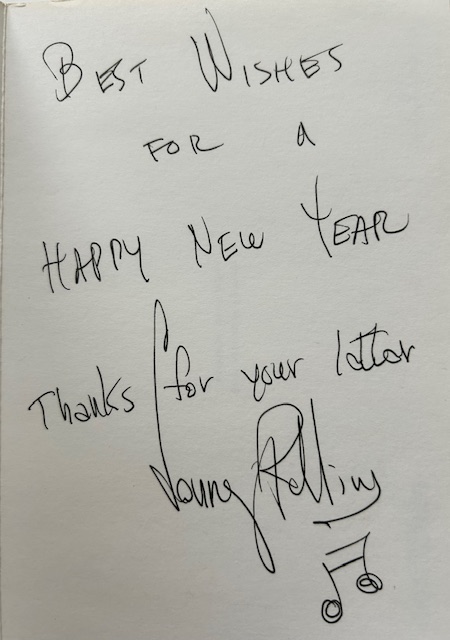
The keystone figure of my jazz concert-going over a decade of my life was the aforementioned Theodore Walter “Sonny” Rollins. Although I never met Sonny in person, I saw him perform five times, and he replied to a letter I once wrote him with a beautiful hand-signed card. His rich tenor sound was almost cavernous at times but always flowing with ideas. I didn’t have a driver’s license in 1998, but I had two tickets to see Sonny for the first time at Pennsylvania’s Keswick Theater, so my cousin Steve supplied the transportation and made use of that second ticket. In 2000, I took my mom and George to see Sonny on the University of Pennsylvania’s campus, and they didn’t need to be jazz fanatics to appreciate what he could do with his horn. In 2007, I took a girlfriend named Meredith to see him at the Kimmel Center — and I’ll simply say that Sonny didn’t mess things up for me.

The card that Sonny Rollins sent me in response to receiving my letter written to him.

During those first voracious years of listening, so many things grabbed my attention. I learned how Charlie “Yardbird” Parker and his alto sax revolutionized jazz during the World War II years. In 1949-50 Parker recorded a double album full of standards backed by strings and the drum mastery of Buddy Rich as a kind of elevated platform for the genre and his own innovations. A decade later, tenor saxophonist Stan Getz picked up this torch and produced 1961’s Focus, featuring an amazing 8-minute improvisation of a certain Alice in Wonderland theme called “I’m Late, I’m Late” — with drummer Roy Hanes’s invigorating rhythms and a philharmonic string section. I followed my father’s advice and listened to the electric, bluesy magic of Cannonball Adderley’s “Mercy, Mercy, Mercy” from 1966 and later found a track I remembered from the radio when I was little: “Birdland,” an electric jazz-rock blend and an homage to a famous New York club named after Parker by the band Weather Report. The tracks on their album Heavy Weather became the soundtrack for science fiction books that I was reading that year including the novelization of 2001: A Space Odyssey and Niven and Pournelle’s futuristic page-turner Oath of Fealty.

In 2000 I couldn’t help but enjoy Ken Burns’s 18-hour documentary Jazz. He and his team provided a comprehensive and justified focus on the lifetimes of Duke Ellington and Louis Armstrong and an examination of the racial dynamics and injustices of U.S. history as they pertained to this art. Even so, Burns greatly truncated everything that happened after about 1961, which fed into the idea that the music stopped or died by the 1970s. The album that I kept thinking of that he left out was a 1975 Atlantic Records dual release called Changes One and Changes Two by the bassist and fiery bandleader named Charles Mingus. Maybe it was Mingus’s intense temperament that gave birth to Changes, in which he titled the first track “Remember Rockefeller at Attica” in a statement of political protest. If you give it a listen, that track is somehow both angry and artfully swinging. In “Sue’s Changes,” I found a recording that rewrote what music was capable of doing. I didn’t think music could be this attractive, revelatory, and off-putting all at once, but that composition, which was written about Mingus’s wife, mixes pure creativity with a fiery kind of journalism for a full 17 minutes. 

As I sat with the music and found the works that really moved me, I began to see the relationships that were at the heart of this music. Julian “Cannonball” Adderley and his brother Nat welcomed the Austrian-born Josef Zawinul to play piano and compose in their groups for 10 years of brilliant partnership and exploration. If you want to get a sense of how creative and catchy Zawinul could be (and how good of an ear Cannonball had), just listen to “Scotch and Water” by the quintet in 1961. This kind of union forged in the development of great jazz could be seen in cases such as Duke Ellington’s musical commitment to Billy Strayhorn as well as the interactions and expeditions of Miles Davis with Gil Evans. Like Adderley, John Birks “Dizzy” Gillespie found his own piano genius collaborator from abroad: the incomparable Lalo Schifrin, who hailed from Argentina. Schifrin would go on to create some of the most memorable original soundtracks, including those of T.V. series Mission Impossible and films Cool Hand Luke, Enter the Dragon, and jazz devotee Clint Eastwood’s Dirty Harry pictures among many others. Going back to the early 1960s and listening to Schifrin’s work with Diz underscores the paradoxical combination of showmanship and discipline found in jazz. In most of these pairings and so many others in the genre, ethnicity and nationality didn’t matter — or if they did matter, these elements enhanced through respect and investment the quality of the resulting repertoire. In 2008 Willie Nelson and jazz great Wynton Marsalis produced a collaboration in this same spirit of meeting on common ground called Two Men with the Blues. These instances of musical co-piloting remain one of the most powerful attractions of jazz for me. 

In 2003 I went to the Philadelphia Art Museum to see and hear the music of the maestro Kenny Barron and his trio. The sparse crowd was a bit of a disservice to the quality of the music, but it gave me the opportunity to sit right in the front row and take in the sound thoroughly. Kenny performed contemporary jazz standards such as James Williams’s “Alter Ego” and his own originals, and that concert completely raised the bar for me on how personal and beautiful music could be. After the concert, the thin crowd was once again a benefit as I had the chance to say hello to drummer Ben Riley, who had played in Rollins’s band back in (once again) 1961, appearing on the milestone recording The Bridge. Afterward, I even had the chance to introduce myself to Kenny and to convey a greeting from an old friend of his who was a coworker of mine. These small moments of connection, however brief, underscored for me the idea that although jazz had long ago become a path less traveled, the music spoke to me personally and maintained persistent relationships with almost every aspect of life.

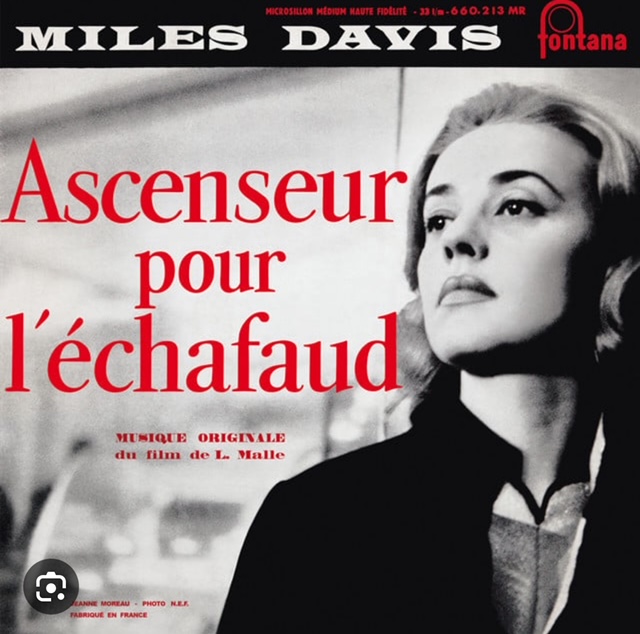
Jazz lends itself quite well to the visual side of things, for example, so it’s appropriate that some of the most innovative film directors have used jazz in the manner of a key supporting cast member in their works. Otto Preminger enlisted Ellington to score the 1959 film Anatomy of a Murder. There is something so satisfying about watching Jimmy Stewart playing up his “old country lawyer” persona in the film as Duke’s distinctive band and arrangements set the mood and accompany the action. At one point, Jimmy Stewart sits down on the piano bench with Duke as he plays in a bar, and Stewart and the film’s creative team had to fight to keep the scene of a black man and a white man sitting together in the final cut of the film. The freedom and goodwill of the music aligned with the freedom from unjust social constraints. In a case of jazz and film cross-pollinating abroad, in the late 1950s the Frenchman Louis Malle was developing his debut dramatic film, Elevator to the Gallows. As a fan of the music of Miles Davis, Malle took advantage of Davis’s presence in France at the time to approach him about writing and performing the score. Malle established a truly collaborative partnership with Davis. The American became acquainted with the film’s story and then produced music organically that supported and accented the plot and characterization deftly. This artistic connection unmistakably contributed shortly thereafter to the approach and the craft of Miles’s 1959 LP Kind of Blue, the best-selling jazz album of all time.

Cover of the French edition of the soundtrack to Elevator to the Gallows

Let’s go back to 1998 one more time (if only that were possible). That album by Sonny that I found was called Don’t Ask. It was recorded in 1979, and the key collaborator on this thing was a guitar player whom I’d never heard of before named Larry Coryell. I had grown up listening to the guitar pyrotechnics of my uncle Michael, but I would go on to learn that Coryell had played a key role in the path of this instrument, building on the seminal work of giants such as Les Paul, Charlie Christian, and Montgomery. In this pairing with Sonny, the track “Disco Monk” was one that I shared with anyone who would listen. People would listen and then simply stop and laugh as the piece’s radical shifts in tempo took them off-guard. The critics largely regarded it as a failure, but for me this track bridged the flamboyance of 70s dance music with the deep meditations in the monastery of melody and improvisation. I consider myself very grateful for whatever luck and synchronicity brought those two musicians and supporting cast together for that one-off recording. 

Finding new and inspiring music is always great fun, but jazz has continually provided me with old and inspiring music that was new for its time. Last year I had this kind of experience when I came across the Vince Guaraldi Trio’s recording Jazz Impressions of Black Orpheus from 1962. Guaraldi had been inspired by the movie referenced in the title, and he was one of the early takers on Bossa Nova — but with limited interest at the time from record labels. This moment was before his iconic piano stylings would become the soundtrack for the Charlie Brown and Peanuts TV specials. Guaraldi used this album as a bridge from cinematic and rhythmic inspiration to an unexpected place as he found a spot on the pop music charts with his 3-minute single “Cast Your Fate to the Wind.” Other moments on that same recording foreshadow Guaraldi’s sound as Schroeder’s piano on the Peanuts specials — as good of an illustration as one could find of jazz’s essential position in American culture. 

I know that the vast majority of people to whom I talk these days will never have heard of Sonny Rollins. That’s OK — we now live in times in which the canon is broader and more diverse and changeable than it ever was in 1960 or 1850, and music is not about checking boxes. It never was about that for Sonny, who turned 93 years old last September. Today, The main thing for me is that as Campbell said, I was caught by it. I found that same feeling of contented captivation in 2019 after we had just moved into the house on the street named for hope. I was building a rocket made of almost 2000 pieces, following the directions on every page. As I did so, my then 2-year-old daughter would steal a piece or use the spares to make something unpredictable of her own design. As we worked, or played, we listened to a 2018 disc called Flight by pianist James Francies from Houston, appropriately enough. The title track seemed to go well with the building of the spacecraft, and another one called “A N B,” gave me a feeling of floating in zero gravity. In this way, music has been the art with which I have lived the most, and across the globe, that is probably as close to universally true for folks as anything is.

So with that, if you hear the drums of Art Blakey, the reeds of Sonny Rollins, or the voice of Sarah Vaughn, and you enjoy some of those sounds, well — then that’s one of our connections.

C.S.

The Proving Ground and The Magic

As much as we may want to separate it because “it’s only a game,” the fact is that the ring, the courts, and the field are all part of life, and life intrudes on these spaces even as they carve out a realm of action that reveals a side of humanity just as poignantly as the novelist or the actor does. In my case, it started off with basketball — the sport that can be played with a ball, a floating circle, and one, two, or ten players. In my teens, I pivoted into a fascination with the history and the art of one of the oldest and most brutal sports: the sweet science of prizefighting. I studied the old footage and the rivalries and read Muhammad Ali’s autobiography The Greatest with deep appreciation. There would be one more sport to discover just as I was turning seventeen, leading into a lifetime of switching roles from watcher to competitor and back again across an array of backyards, fields, and courts.

So came tennis into the picture for me in 1989 in the form of the green grass of Wimbledon hosting the lightning serve and the aggressive net play of #3 seed Boris Becker of Germany. In those days, HBO showed the early round matches, and I was out of school for the summer. I had never really sat down and closely watched a tennis match before that moment. There was something about the pomp and quiet buzz of the old Centre Court stadium. Oh sure, I’d grown up with John McEnroe, Chris Evert, and Connors on the TV, but we were more likely to be watching the Phillies or the Sixers in those days as opposed to tennis matches. In that ’89 Wimbledon, it must have been in an early round match that I saw a player try to hit a lobbed ball over Boris’s head; his back was almost turned. In a split-second decision, he leapt upward from the grass and brought the racket in a windmilling motion and with a hammer strike and flick of the wrist slammed the ball down with a thwacking bounce on the opponent’s court for the point. That single point in the tournament reeled me in to the sport and instantly made me a Becker fan. He went on to defeat world #1 Ivan Lendl and to win the championship over Stefan Edberg, so it was a magical introduction to the serve and volley version of this sport.

In those same years, I was waking up on Sunday mornings to watch Randall Cunningham quarterback the Philadelphia Eagles against the teams of the NFC East, but more importantly, I was at the beginning of my years of playing pickup basketball. I had never been much of a joiner in my youth, so I missed out on organized sports through the school years while I was nerding out with science fiction and collectibles. My experience was a contrast from my father, who must have told me as many as 15 or 20 times about that clutch jump-shot he hit in his 8th grade basketball team’s 19-18 championship victory in the new gym for which his mother had raised the funds. I, on the other hand, found my way into a streetball game with my father in March of 1990 in what became an unforgettable moment. We fell way behind by a margin of 18 baskets to 10, but despite the deficit, my father at 45 years old turned on his best defense and ball distributing skills while I made one key rebound and a basket — a double stat, the old gym rat would say. We won the game, and months later, I started going to that park in South Ardmore two or three nights of every summer week. I was a left-hander, and I developed a jump hook-shot that my opponents might view quizzically or even with laughter — until they had to start covering it. Years later, sometimes my father would give me a sneaky look and remind me of that 18-10 deficit in a game that we went on to win 21-20.

Image: Varun Kulkarni / Pixabay

As a child, I had often gone with my dad’s family to see my uncle Danny play basketball for Haverford High School. My grandmother attended every home game and recorded his stats with religious accuracy. Danny was a shooting guard with a dynamic but shrewdly efficient style of play, and he was one of the best high school players in the Pennsylvania suburbs by the time he was a senior. I remember being in those full, echoing gymnasiums, watching his games and occasionally sneaking under the stands as the game roared on. At home I would switch between reenacting Dr. J’s 76ers playing the Los Angeles Lakers and Danny’s Haverford Fords (yes, the car) playing the Radnor Raiders (now Raptors) with my Nerf basketball set. Dan was on a short list of good-looking, standout high school athletes in the area, and now an image comes back to my mind: a long-lost, post-game photograph of me with one of the best basketball players from the Pennsylvania Main Line suburbs. I am posing with flushed cheeks and a big smile and holding up my finger in a “we’re number one” gesture alongside of the great forward Dion Irons, who was in his green and yellow Springfield Cougars uniform. I wish I still had that photo. The young athlete’s amiable expression and the look on my face together tell a story about the inspirational aura of sports.

Through my college years, my dad and I continued to play basketball at South Ardmore. Sometimes there were daylong winning streaks filled with camaraderie, and other times there were arguments, dirty fouls and rancor — kind of like life itself but magnified. Sport runs deep in our families and in American culture, marking memories and eras. A great-grandfather of mine had been an amateur boxer just after World War I, and Meredith’s maternal grandfather Gene played college basketball during the next global conflict. Half a century later, as I watched the 1990s come into their own identity, the ascendancy of Michael Jordan arrived as both a basketball talent and a new media star. In those same years, Boris Becker competed against increasingly long odds versus a trio of American competitors in Pete Sampras, Jim Courier, and the energetic Andre Agassi. On the ladies’ side, the comprehensive athleticism and will of Martina Navratilova was giving way to the brilliant play of the younger Steffi Graf. The Williams Sisters would take the courts by storm before the end of the decade.

In early 2004, as I was preparing to embark on my career as a high school English teacher, I began to increasingly hear the name of a player from Switzerland who was beginning to dominate the major tennis tournaments: Roger Federer. During those summers, in the mid-2000s, I would watch the Wimbledon matches in the morning and then go out to that same tree-lined basketball court in Ardmore to try to get into games of 5 on 5. My father was nearing 60 years old, so I was more often going there by myself. Basketball was my mill and my proving ground; tennis was a global event that I little understood but couldn’t pull myself away from watching.

The question comes to mind — why tennis? I had never played the sport, so after Boris Becker drew my attention, what kept it? In some ways, my answer goes back to the sport of boxing. I was such an enthusiastic fight fan that I had created my own homemade boxing game based on role playing game principles. I had watched and collected old videos of Muhammad Ali and Sugar Ray Robinson while also following the career of Mike Tyson. However, after a decade of following the sport, I could see that boxing was leaving a trail of ruined careers, brains, and lives. The sport had such a rich history that mirrored some of American society’s most pivotal events such as Jack Johnson’s clashes with both opponents and the color line or Joe Louis’s symbolic and inspirational World War II era battles. Nevertheless, for me the sport was dead on arrival by 2000, and I’ve never been remotely interested in the off-putting boxing/martial arts mash up that is known as ‘ultimate fighting.’

Singles tennis had the one-on-one confrontation of boxing without the element of unavoidable physical harm or the parasitic people who managed the fighters. Tennis was the same kind of contest of will, strength, and finesse as a boxing match — and in men’s singles with 5 set contests at the major Grand Slam tournaments, the sport required incredible endurance. Tennis also had something that really no other sport had: distinctive surfaces that shaped the game and the expectations of its competitors.

In the 1990’s I had to respect the singular effectiveness of Pete Sampras and his booming serve on the Wimbledon grass and hardcourts of the U.S. Open, but I had looked for players who could emerge to challenge him and inject new rivalries into the sport. After Sampras, in 2004 Federer was driving toward the pinnacle of the sport on those same courts. With his elegantly swept one-handed backhand, laser service game, and the ability to shorten points down to a minimum of options for his opponent, Federer was poised to thoroughly dominate the sport for the years to come. I was searching the landscape for a new kind of player who could successfully challenge him.

It turns out that to find that player, I needed to watch a different version of this same sport: clay court tennis. A player from Spain named Rafael Nadal was pouncing around the red, dusty courts of western Europe and honing his own brand of high energy tennis. He took charge of Roland Garros, the only clay court Grand Slam tournament, and in time, he would break Roger’s winning streak on the Wimbledon grass in a historic five-set match in 2008. At that same time, Novak Djokovic of Serbia and the Scotsman Andy Murray were also showing signs that they would make a lasting mark on the sport.

Image: Pexels / Pixabay

In the history of sports both ancient and modern, there have been droves of talented athletes, memorable personalities, and more sparsely, forward-thinking activists. The rare players who combine all three of these qualities are able to elevate both the level of play in the sport and the social consciousness of people around world. Muhammad Ali and Billie Jean King are two such athletes who have helped to show that sports can be a platform for both competitive genius and positive change. Ali refused to take the step forward to be inducted into the U.S military during the Vietnam War on the basis that his country needed to change its treatment of its Black citizens and the fact that he had no quarrel with the government of North Vietnam. Ms. King was in the midst of a dominant tennis career when she took up the added challenge of setting a new path for women’s tennis by founding the Virginia Slims tennis circuit as part of the Original 9. This organization became the Women’s Tennis Association and ushered in a period of greater standing and better pay for women’s tennis. Tennis’s Big 4 as they have been called, have been much more known for their on-court efforts, but Andy Murray has taken the baton in his own modest way from activists of the past by speaking out on behalf of the concerns of women players and as a thoughtful voice on political issues in a matter-of-fact way.

From 2005 through 2020, over 15 years of rivalries, changes of seasons and surfaces, injuries, controversies, winning streaks, and occasional upsets of an historic nature, This Big 4 has spun a story of staggering prowess and brilliance under pressure. At 36 years of age, Roger Federer achieved that which was previously unthinkable in the men’s game, winning a record 20th Grand Slam singles championship in Melbourne in 2018. Both Nadal and Novak Djokovic would forge onward in the seemingly impossible goal of tying and surpassing Roger. Along the way, Djokovic called upon a retired all-time great to serve for several years as his coach — the colorful personality who is Boris Becker.

Meanwhile, Andy Murray had gone on to win his second Wimbledon singles title in 2016, but unfortunately a hip injury in the following year put him on the verge of an early retirement at 31 years of age. All this time, Serena Williams emerged as the runaway ladies’ champion of her era, surpassing her sister Venus and eventually winning the Australian Open in 2017 for her astonishing 23rd major — even doing so during the beginning months of her pregnancy.

During this time I continued to play basketball and shadowbox out in the backyard — except in 2011, the backyard had changed from one in the suburbs of Pennsylvania and the streets of Philly to the Capital of Texas. In Austin, I took advantage of the trails and green spaces and drew inspiration from another outspoken athlete: the Oregon track star named Steve Prefontaine. In his brief life and fiery career as a middle-distance runner in the 1970s, Prefontaine was known for his big attitude and domination of races from the opening pistol. He was also known to shake up his sport and the status quo as an activist on behalf of amateur athletes and against the arbitrary restrictions of the Amateur Athletic Union. For me, Pre brought out the appeal of committing to a run and — just as Bruce Lee said about martial arts — finding self-expression through this form of exertion.

The old loyalties and rivalries in the sports world were occasionally stirred by a Cinderella championship run, including a Phillies World Series title back in 2008 and most memorably when in early 2018, I watched from Austin while holding a five-month old girl as the Philadelphia Eagles defeated the dynasty of the New England Patriots in a Super Bowl that provided a long-awaited first for Southeastern Pennsylvanians and the region’s diaspora of fans that stretched even as far as Northern Ireland in our family. In 2013, I had lost John, so watching the Birds or seeing Nadal play for the US Open championship were things that connected my old life to the present in a bittersweet way. He had been my biggest fan and my most frequent teammate in my informal competitive life. In one pickup b-ball game probably back in ’93 or so, I was posting up while being covered by a guy who was friendly with us. John was dribbling up top over to my side of the court, and I was moving into position when the guy quietly said to me, “Here comes your pass.” I could just about hear the slight, sideways smile in his voice. He was right.

While sports hold a religious level of devotion for millions of fans globally, I have to acknowledge that being overly invested in this world of competition can have a number of downsides, particularly in collegiate and professional sports. The resources put into organized sports often seem to be at odds with the priorities of a serious and compassionate society. I’ve already cited the layers of danger and the harms caused by prizefighting, but the revelations about the extent of CTE (chronic traumatic encephalopathy) as a widespread malady in current and ex-football players have really given me pause in my once vibrant enthusiasm for that sport.

Meredith’s father and her late uncle knew quite well the challenges of the professional side of sports. Her uncle Rob had been a flanker for Texas Tech University, and he had gone on to a significant career as an assistant coach for several collegiate programs and later as a high school athletic director. My father-in-law had been a formidable tight end in college for the SMU Mustangs and had played professionally for a Louisiana franchise known as the Shreveport Steamer in the first iteration of the World Football League in the mid-1970s. The two brothers had even played each other when their schools squared off on the field one season. They competed in the face of uncertainty, occasional injury, and the pressure to succeed in a game with high stakes and then, maybe just as difficult, to make the most of life after the walk off the field.


In most cases in the world of sports from recreational to amateur to professional, the goal is ultimately to win, but the real imperative and the great joy of sports for me are found primarily in going out there and playing well. I’m not saying I don’t want the victory, but there is another dimension to sport besides defeating an opponent. There is the competition within the self, the sense that I am getting better and exploring more of my potential as a player and as a human. It’s connected to the way in which runners are often more interested in their individual times rather than what place they finish in a race. Playing well also includes sportsmanship, which reinforces that no matter the level or age of the players, the regard for one’s teammates and opponents alike is essential.

The 2020’s have not proven to be the best vision for which we might have hoped in life and sport. As a result of the Covid-19 pandemic, Wimbledon was cancelled in 2020 for the first time since World War II. The previous year, Novak Djokovic had asserted his primacy at the event by fighting off two match points to roar back and defeat Roger Federer for that coveted championship. However, 2020 had its own strange logic and alienating pattern, and the fortunes of Djokovic tracked in this way as he made the error of organizing an exhibition tournament for charity in the midst of a global tide of coronavirus. A number of players became infected, and the final was cancelled. Later on in New York, Djokovic was defaulted when he carelessly struck a ball away that ended up hitting a line judge in the throat. He was later defeated by Nadal resoundingly in an out-of-season French Open final.

In 2021, Andy Murray defied the odds and came back to Wimbledon with a metal hip and the desire to compete again. Djokovic was playing unmatched tennis, having scored a rare victory against an ailing Nadal on his favorite clay in Paris, and Djoker went on to add another Wimbledon title to his resume with an inexorable win over “the hammer” of Italy, Matteo Berrettini. After two weeks of dominating the New York nights at the Billie Jean King Tennis Center, Djokovic found himself one match from surpassing Nadal and Federer for a record 21 majors — with the additional stakes of winning all four Grand Slams in a single year. For the championship, #1 ranked Djokovic would play #2 ranked Daniil Medvedev of Russia.

In the same September in which Medvedev dealt Djokovic a stunning defeat in New York, Meredith decided it was time that I start to learn about this sport firsthand. She signed me and Natalie up for our first ever tennis lessons one cool Sunday morning. We brought our brand-new rackets to our respective courts, and in the “redball” class for 3- to 4-year-olds, Natalie warmed our hearts by seeming to take to the sport with enthusiasm in her first on court experience. That morning I had the benefit of a relatively young player-teacher who must have been on the pro tour fairly recently: by his own account, he had once played then-U.S. Open Champion Medvedev. It was an admittedly thin connection, but John loved those kinds of markers of proximity to greatness, no matter how slight the link.

Back in the mid-1980s while he was working on his songs in L.A., John was playing pick-up basketball and 3-on-3 games when he squared off with a high school senior named Paul and beat him in one-on-one. The kid was so impressed playing with and against my 40-something dad in only a few meetings that he asked John to coach him and his friends in a tournament. I believe it was sponsored by McDonald’s, and according to Johnny’s own legend, they made it into the final eight before they were eliminated. As a result of the surprisingly good showing by the unheralded team and Johnny’s courtside coaching antics, he was invited to play in a “VIP” basketball game. Watching from courtside his players made a bet with another spectator: if John gets in the game, no matter how little time he is on court, he will score. My father got his chance. Shortly after entering the game, he caught a pass and released a baseline jump-shot somewhat casually. His shot was blocked by a fellow VIP playing on the other team — Olympic high jumper Dwight Stone. The next time John caught a pass on the wing while readying one more (and likely his last shot) he pump-faked, watched his defender sail past him, and arced his shot right through the net. Out of the corner of his eye, he saw his players celebrating in the stands while the game’s announcer, LA Lakers coach Pat Riley, called out “…And that’s the Music Man, John S–!” In that way, John brought out the magic of sport.


In January of 2022, after a saga that burned across social media and breaking news reports, Novak Djokovic was detained and eventually deported from Melbourne, Australia for not having received the Covid-19 vaccine. Two weeks later, it was quite a strange Sunday morning as I snoozed on a foldout mattress nursing my own Covid-19 infection while keeping tabs on my six-month old son, when I woke up to a buzzing alert on my phone that Rafael Nadal had become the first man to win 21 Grand Slam titles with an unheard-of, from-the-brink comeback win against Medvedev 2-6, 6-7, 6-4, 6-4, 7-5. Months later on the red clay in Paris, with cortisone injections in his ailing foot, Rafa won another 4-hour war in the quarterfinal with Djokovic and went on to make it 22 in ’22.

The twists didn’t end there. In the spring, Boris Becker was sentenced to a jail term for violating the legal requirements of his bankruptcy, and after the horrific invasion of Ukraine by Putin’s Russia, The All England Lawn and Tennis Club instituted a ban on Russian and Belarusian players from participating in the Championships at Wimbledon. Medvedev and his compatriots were barred from the competition. Djokovic tore through a politically and medically decimated field and claimed his own 21st Grand Slam, close on the heels of the new leader. Amazingly, in the men’s singles championships held at Wimbledon over the last 20 years, only Federer, Nadal, Djokovic, and Murray have been the winners. This elite level of performance by these four players has been a gift to those of us who have had the time and the good fortune to follow these storylines. The rare breakthrough performances of new faces in these years such as Juan Martin del Potro in New York and Stan Wawrinka at Roland Garros helped to underscore just as clearly the high standards of this competitive era.

In the summer of 2022, I was home on a rare evening by myself in Austin and went to the park across from our neighborhood. I met a group of guys in their 20s and early 30s who were playing half-court basketball, and just as I would have done in Philly or Jersey years ago, I introduced myself and ended up playing a game with them when one of them had to drop out and leave. I hadn’t played basketball with anyone in three years, but I had been practicing occasionally in the Texas heat. I managed to make a couple of shots and held up my end of the bargain on defense, but I was tired. Then, with the contest on the line and a lucky bounce here or there, I caught a pass, squared up, and hit the game-winning shot. I decided not to tell them that soon I would be turning 50. It was just good to be on the court again. This same summer, our little blonde-haired boy was taking his first steps and saying his first few words. I find it appropriate and probably a fitting tribute to a pair of grandfathers and two dearly missed uncles that one of those first words was simply “ball.”

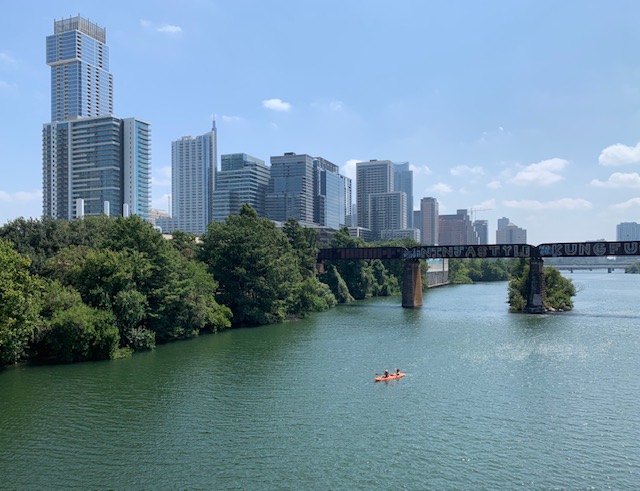
Austin, TX

C.S.

Cold Wars and Queens

I was recently watching an old television show from 1967, when one of the characters asked, “What kind of men are always above board?” The answer: chess men. Never mind that the program was Batman or that the character was Frank Gorshen’s irrepressible Riddler. In theory, chess could be considered the ultimate meritocratic competition. In practice, for a quarter century now and counting, human beings have lost their standing as the rulers of the game as computers have far outpaced us in this arena. However, this development has served both to reveal the depth of the game and to refocus our attention on the human significance of chess on several levels. Through stories imagined and true, it is possible to see beyond wins and losses to understand how chess paired with culture can serve as a window into human agency and progress.

At the end of 2020, I joined the mass of people around the world who watched Netflix’s The Queen’s Gambit. As an unskilled but enthusiastic player and observer of chess, I’ve always enjoyed seeing on-screen portrayals of this competitive form. The Beth Harmon character in Gambit (played by Anya Taylor-Joy) was realized with appropriate gravity and naturalness, and the sport as a whole was given a remarkable canvas despite the deft avoidance of deep chess strategy. It’s a credit to author Walter Tevis that his novel of nearly forty years ago could provide a period piece that felt fresh and relevant and also seemed to capture both the past and future of the sport.
 
For decades television and film creators have used chess purposefully in their art. In old cat-and-mouse detective shows such as Columbo or Banacek, chess might come up as a peripheral device to show the intellectual capacity of the antagonist or as a marker of the foresight of the hero. In the series The West Wing, President Jed Bartlet played chess with his communications director in order to maintain his mental sharpness. Perhaps its most strategic use was in Jim Jarmusch’s film Ghost Dog: The Way of the Samurai, in which chess plays an altogether different role: a communication device that shows how two people transcend a language barrier between English and French. As it turns out, in most cases the best filmic explorations of chess originate from the lives of real players — often featuring storylines that are as surprising as anything found in the narrative of Beth Harmon.
 
In the documentary Game Over: Kasparov and the Machine, we are given a ringside seat for the ultimate man vs. machine moment as one of the most outstanding chess performers of all time, then-world champion Garry Kasparov, loses in his much publicized rematch with the IBM computer Deep Blue in 1997. Kasparov’s frustration in this film is both palpable and completely understandable, as he competes with a faceless opponent and an equally opaque team of IT developers. The film turns on a conceit referring to “The Turk” — a legendary unbeatable chess-playing automaton that conceals a hidden human player. The tone of this film is somewhat like a potboiler in contrast with more typical documentary approaches, but the story is a worthwhile precursor to the present, in which the current FIDE World Champion Magnus Carlsen and his fellow grandmasters consistently use a combination of digital chess engines and human play to develop their abilities.

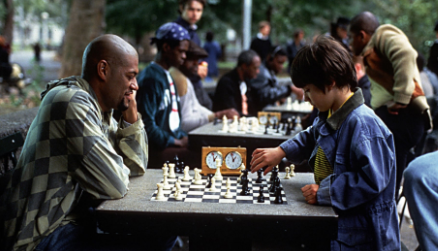
Photo credit: Gorodenkoff / Shutterstock.com

In 1984’s Dangerous Moves (La Diagonale du Fou), an old Russian grandmaster must defend his championship title against a younger master and defector to the West. In one of my favorite moments of dialogue in the film, the aging champion, who is in declining health, tells his second to do away with his cigarette during a practice game. “But it’s not even lit!” is the reply. The old grandmaster intones, “But you threaten to smoke it; in chess, threats are more serious than actions.” The story delves into psychological advantages and suspicions between opposing sides that are a hallmark of the sport’s history in the cold war years. The movie draws on a similar real life confrontation, a 1978 match between Anatoli Karpov and Viktor Korchnoi (who had defected), in which a number of bizarre extracurricular tactics and accusations took place. It may be necessary to point out that in fact, not all chess men are above board. However, Moves goes beyond its historical precursor by examining the deeper motivations of its two competitors, unlocking influences of not only the national tensions but tribal and emotional ones as well. It was awarded the Oscar for Best Foreign Film of the year.

When it comes to the American milieu, the obvious standout figure in our chess history is Bobby Fischer, and in the surprisingly well-crafted 2014 film Pawn Sacrifice, Tobey Maguire adeptly embodies the brilliance and brittleness of the late grandmaster. In fact, the film is challenging to watch at times specifically because of how volatile and disagreeable Bobby Fischer could be — especially the closer that he came to the world championship. In the supporting role of Father Bill Lombardy, actor Peter Sarsgaard serves as a layman’s chess translator and a conscience in whom the viewer can invest when Fischer’s anti-social and anti-semitic tendencies manifest. When high value pieces are exchanged in one sequence, Lombardy reassures Fischer’s agent that everything is fine because it merely “simplifies the game.” Later on Lombardy uses the story of the brilliant 19th century American player Paul Morphy to serve as a warning about the pressure that chess at the highest level of competition can put on a person’s psychological wellbeing. In the role of the Russian champion Boris Spassky, Liev Schreiber does a wonderfully understated job — conveying at the ending a moment that seems to be the historical influence of this match on a pivotal gesture in The Queen’s Gambit

In the collective memory of our culture the flaws and inconsistencies of Bobby Fischer tend to be outshone by his early years of brilliant play and the success of that moment in 1972 on the world stage in Reykjavik, Iceland. It is that memory and the void created by Fischer’s desertion that serves as a challenge to be answered in the outstanding feel-good film Searching for Bobby Fischer — the true story of a boy named Josh Waitzkin. It’s a child prodigy sports film that manages to celebrate winning while also putting victory in perspective behind the concerns of childhood and most importantly, being a decent human. One of my most prominent memories of this film comes back to me from my years as an inner city high school English teacher. I used the film as a culminating visual partner to reading Paul Zindel’s Pulitzer Prize winning 1974 play, The Effect of Gamma Rays on Man-in-the-moon Marigolds, a straightforward but challenging drama about a dysfunctional family and a little girl who is discovering her love of science while learning to bloom in her own way.

Laurence Fishburne and Max Pomeranc in a scene from
Searching for Bobby Fischer (1993)

My students didn’t need to be skilled in chess to be reeled in by Josh’s story. Director and Screenplay author Steve Zaillian makes the most of both Fred Waitzkin’s original story and a vintage 1993 cast boasting the likes of Ben Kingsley, Laurence Fishburne, and Joe Mantegna. The minor roles of William H. Macy as an excitable chess dad and Laura Linney as an elementary teacher show their consummate skill years before their well-earned fame. Fishburne is dangerously close to being a trope (long before The Matrix) as a chess “street guru,” but he is so engaging that we look forward to every second his character can be on screen. As Josh’s mother, Joan Allen embodies the moral center of the story. The cinematography by Conrad Hall is music to the eyes, somehow making an ancient game of 64 squares into a centerpiece of timeless childhood and the effort to prove oneself. If you have not seen the film, tonight or as soon as you can would be a good time to watch it from the first move to the last.

For many young people (and their mentors) chess has served as a validation of intellectual ability and a proving ground for self-worth. It had been years since I had seen John Leguizamo in a film, but his 2020 passion project Critical Thinking brings to the screen — with his younger co-leads — the experiences of a brilliant Miami chess team made up of Black and Latino high school students whose academic prospects and futures might not have looked particularly rosy at first glance. The movie undeniably has a Dangerous Minds kind of quality as it introduces real life teacher Mario Martinez, and the violence of Miami’s streets is made clear early on in the story. When Mr. Martinez’s students ask why the deck feels stacked against them, he explains that the accomplishments of people of color have been written out of history in many cases, and in chess history he refers to the fact that players like Kasparov and Fischer are well-known figures, while Raul Capablanca, an all-time great world champion from Cuba, was a name unknown to these teenagers. Mr. Martinez is the person who anchors these students to tap deep into themselves to change the nature of the conversation.

In discussing what spurred him to make the film, Leguizamo reveals a negative inspiration: he found the underdog success story of these boys and their teacher to be what he termed an “antidote” against one of the most infamous works of sociology written in the past century: Charles Murray’s 1994 work The Bell Curve. This text aggregated research on intelligence across broad racial categories with the (intentional) effect of propping up reactionary views of race and society. Mr. Leguizamo felt that the story of this group of students in Miami at the turn of the 21st century was one way to counteract the racist assumptions lurking behind Murray’s decontextualized data and generalizations. The inescapable Russian influence on the game takes an interesting form here as well when the protagonists are joined by a savant-like Cuban immigrant who has had the benefit of the Soviet Union’s influence and chess training back on his home island. 

During the fall of 2016, the Walt Disney Company teamed with ESPN to release a memorable story in the genre of this game on screen. The film Queen of Katwe brought the world the adventures in the life and chess of Fiona Mutesi. As I anticipated rewatching the film I looked forward to seeing the crisp photography and the nonstop symphony of prismatic images from Fiona’s home village in Uganda. In one of my favorite sequences, a young player named Gloria introduces Fiona to the game, bluntly but mischievously telling the newcomer while moving pieces, “They kill each other!” Gloria also teaches Fiona the game’s most inspiring rule: if the lowly pawn traverses the board to the final opposing rank, it can become a queen, the most capable piece on the board. This movie follows a familiar arc of growth and a heroine coping with privation en route to emergence with her individual brilliance, but the work by Robert Oyewolo, Lupita N’yongo, and Madina Nalwanga are true to the urgency of the lives they portray, and the aforementioned iridescent colors of central Uganda are humanly magnetic.

No catalogue of this topic would be complete without the mention of one more documentary. 2012’s Brooklyn Castle demonstrates how the pursuit of excellence in chess can align with academic growth and a sense of teamwork among students who are just breaking into their adolescence. I first became acquainted with New York City’s I.S. 318 and some of its students and teachers in Paul Tough’s 2012 book How Children Succeed, which spends several thoughtful chapters describing chess teacher Elizabeth Spiegel’s devotion and effort to fully developing the various abilities of her middle school chess students. The game is often used to teach about life off the board. Seeing Brooklyn Castle provides a useful framework for understanding just how rewarding and martialing it is for young people to have a rigorous source of engagement and tutelage in disciplines such as chess, art, and music.

These matches and films bring me back to 2016, the first year in which I actively followed the world championship. I was curious about the mystique and the dominant record of the titleholder, Norway’s Magnus Carlsen, who achieved the highest rating of any player in history in 2014 according to the sport’s evaluative algorithm. Ordinarily, I would pull for the challenger in such a situation. However, this match was held only weeks after the 2016 U.S. Presidential Election. Carlsen’s challenger was Sergei Karjakin of Russia, and so I followed each game with an unspoken hope that Carlsen would retain his title rather than giving Russia an additional feather in its national cap, especially in this sport, after Putin’s latest exploits. It may have been unfair to Mr. Karjakin to hold the machinations and geopolitics of his country against him personally, but in some ways, I was merely revisiting a longstanding and aforementioned role that this sport has played as a proxy battleground between political systems, ideas, and symbols.

Squaring off in New York City for the world title match, Carlsen and Karjakin played game after game with no victories for either until the Russian broke through in the 8th game. Carlsen then survived with yet another draw and tied the score with his own victory in game 10. The match remained even after games 11 and 12, leading to four deciding games of rapid chess — shorter, time-pressured matches in which Carlsen was more at home. After two stalemates, Carlsen captured the third face-off playing black, and then in the final frame and Karjakin’s last hope to draw it out further, Magnus set up and successfully launched a late-breaking sacrifice of his white queen to checkmate Sergei in dramatic fashion and defend the title. Two years later in 2018, the United States narrowly missed the opportunity to claim a new champion as Italian-American challenger Fabiano Caruana lost a similarly close match to Carlsen.

Carlsen (left) vs. Caruana, FIDE World Championship match, November, 2018 in London. Photo credit: Bart Lenoir / Shutterstock.com

The significance of games is multifaceted. They entrance and energize us, and to the extent that we are fully invested in these competitions, they validate us — even in defeat. That is the message of Kasparov vs. Deep Blue in 1997. Against the computer, the grandmaster represented us in a voyage to our limits, and what we take from it is to remember that we are not merely artificially intelligent. Our mental power is part of an emotional range. As in life itself, the process of adjusting and improving is key. Drawn matches can be beautiful displays of patience and fortitude, and victories sometimes emerge from winding pathways of uncertainty. That is the wisdom to be found in the narratives of Joshua Waitzkin and Fiona Mutesi, and it is the inspiration of the story of Beth Harmon.

Your move.

C.S.

The Reckoning

Over the past four years in my writing, I’ve only touched on politics at the margins, but with the witches coming out and only days from the final decision, it was time for me to discuss what’s happening for the record.
 
I’ll start off with two fathers, John and George. My father John was a musician who loved sports and lived a life that defied the typical 9 to 5 structure. Big George, on the other hand, was always much more practical: an electrician and property owner who has become a devoted grandfather and one of the most handy guys I know. At some points in the early 2000s, both John and George expressed insights about Donald Trump as a public figure that have aged perfectly. Around 2003, John explained to me that Trump had cultivated a reputation for wealth and success while mostly borrowing money as a route to capital and then walking away from projects while claiming paper losses after having lined his pockets. In recent years the New York Times and Trump’s niece Mary have confirmed and continued to add detail to this understanding of Mr. Trump and the chicanery that is his business model. Some years prior to that when Trump ran as a Reform Party candidate in 2000, he made noises to the effect that he and other rich people should pay more in taxes. I remember talking with George about it at the time, and he looked me right in the eye and said simply, “I wouldn’t believe a word that Donald Trump says.” That position turned out to be good advice. Twelve years later, when Trump engaged in a campaign of disinformation about Barack Obama’s birth certificate, I had a final confirmation that John and George had both been right about Trump and that he could never be trusted on any serious matter. So, as clichéd as it may seem, almost everything I needed to know about the current President was taught to me more than a decade in advance by my dads.

In the role of president, Trump has done the only thing he knows how to do: hollow the marrow and value out of everything he touches in order to make it into his own personal currency. Appropriately enough, before his January 2017 inauguration, he settled to pay 25 million dollars to people who had been the victims of his fraudulent Trump University. Then he installed his daughter and son-in-law in unpaid senior advisory positions for which they were unable to be cleared by the FBI in the normal course of vetting. The two of them have subsequently gained far more in capital in these positions with access to foreign loans and favors than they could ever have earned on a government salary. The most astounding aspect of the 2016 election for me was the fact that Trump had been chosen by some number of voters as a rebuke of corruption on the part of the Clintons. Four years later, the amount of self-dealing, bilking of money out of the Secret Service budget for Trump resort rentals, and acceptance of foreign money and profits in exchange for favorable policies have shown how this presidency and campaign have been a Trojan Horse for one family’s financial interests. 

The pattern was set early on: a grand announcement or some spectacular break with norms that would eventually lead to not just abject failure but a worsening of the status quo. See, for example, the way in which Kim Jong Un used Trump to gain previously unimaginable photo ops for his own purposes and then went on to expand North Korea’s ballistic missile capabilities. At the same time, the Affordable Care Act has been weakened with no remotely plausible Republican healthcare policy in the wings, and the Tax Cuts and Jobs Act of 2017 has not notably increased the average American’s savings despite contributing to a record $3 Trillion budget deficit. Trump views everything in purely selfish terms, and he regularly misses the most important points. He sees Covid-19 not as a genuine public health crisis but as something that happened to his presidency and for which he deserves special accommodations. He believes that the economy is primarily the stock market. His thinking is so transparently simplistic that he has assumed that if the Dow Jones Industrial Average were to reach 30,000, it would guarantee his reelection, and so when the coronavirus began to spread in the United States, he sought to protect the Dow instead of the public.

I am in no way pretending that previous presidents such as Richard Nixon and Bill Clinton didn’t show highly problematic patterns of personal corruption. Neither am I ignoring the colossal failures of the George W. Bush administration nor the sometimes questionable decisions that came out of Mr. Obama’s presidency. However, these few years later with no less than three of Trump’s former campaign chiefs (Paul Manafort, Steve Bannon, and Brad Parscale) either in jail or facing felony charges, it is embarrassing beyond words for the United States of America that we promoted and rewarded people this lacking in character to have sway over our republic. And of course, let’s not forget the pardons for unrepentant criminals like Joe Arpaio, Rod Blagojevich, and Roger Stone—a sideshow and warm-up act for when Trump and Pence may need to pardon members of the Trump family. Perhaps the most damning statement about Trump’s character comes very succinctly from his niece Mary in her book Too Much and Never Enough: “If he can in any way profit from your death, he’ll facilitate it, and then he’ll ignore the fact that you died.” When we examine his coded, mafia-like speech, his incitement of violence toward his opponents, and his handling of Covid-19, including externalities like the death of former presidential candidate Herman Cain, it’s clear that Mary Trump is not exaggerating.

In the 21st century, our globe has entered a phase of some truly problematic trends that will adversely affect food production, migration patterns of both animals and humans, the safety and security of an increasing number of habitats, and the financial security of people in a growing number of regions both here and abroad. Artificial intelligence and automation continue to disrupt the labor market without a clear endpoint or a counterbalancing set of innovations in our infrastructure, safety nets, or affordability of healthcare. American rates of disproportionate incarceration, gun violence, maternal and infant mortality all lag behind our Western peer nations. The opioid epidemic has reached staggering proportions, and to exacerbate these matters, we live in a world in which seemingly magical technology has helped to put false information into the minds of billions of people on an hourly basis. We do not have any more time for bad faith actors who were born into wealth and act only out of the narrowest self interest at the expense of public health and democratic solidarity.

We are living in a time of anti-police protesting, and there is a lot of commentary posted on social media about these protests with the outbreak of violence and destruction of property. A great deal of this commentary implies or states racially biased tropes and puts forth the old warhorse that Trump has been trotting out during his perpetual campaigning: the need for law and order. However, law and order is often another name for the war on drugs, which is the most spectacular policy failure in the history of the United States. The lack of a humane and honest policy for the use of psychotropic drugs and stimulants has gone hand in hand with redlining of neighborhoods, incentives for committing crimes, and policing strategies that are clearly detrimental in cities like Philadelphia, Baltimore, Washington D.C., and Chicago among many others.

If we want to initiate a reversal of the dysfunctional behavior within communities and between people and police, it is imperative that we end this horrible policy of arresting people and criminally prosecuting them for drug offenses. Decriminalize it, legalize it, tax it, and regulate it. Pull the rug out from under this illicit market so that we can get to the business not of defunding the police but rather de-militarizing them and reimagining what the appropriate scope of policing should be. It will take years to fix these entrenched problems, but we can’t wait on the party of Trump anymore because they don’t support or budget for any meaningful reforms that would improve matters in these cities.

I want to pull back for a moment to look at a wider view and a more enduring perspective. In addition to the closest relatives whom I’ve lost, there are certain people whose deaths invoke in me the deepest questions and exhort me to insist on a better path in my life. Sandra Bland, Philando Castile, and George Floyd all come to mind in recent years. In some cases, it might be actors or athletes like Patrick Swayze, Elizabeth Peña, and Walter Payton, whose deaths came from intractable illnesses as they were living the only lives they had. Most recently I have felt this kind of sympathy and inspiration about another great actor: Chadwick Boseman, a person whose Zen-like perspective and generosity of spirit outshone even his fantastic screen presence and craft. I think about the idea as Yogi Berra put it colloquially that it can get late early, so to speak, and given that this phenomenon can happen in one’s life itself, I want to spend my time in a world with leaders that at least have the potential to embody goodness and not this exercise in daily denial of what we all see to be true. In The Great Gatsby, Fitzgerald speaks through Nick Carraway the expectation that people should be capable of standing “at a kind of moral attention” in the context of mortality and life-altering events. I think that a growing number of people in this country are feeling exactly that way.

One prominent bright side to this time for me is the incredible response of activists, neighbors, community leaders, and yes, a wave of newly emerging politicians from a variety of walks of life who care enough to engage in a massive movement that is fundamentally decent and future-oriented. I am speaking of U.S. Senate candidates such as former military pilot M.J. Hegar in Texas, astronaut Mark Kelly in Arizona, and Reverend Raphael Warnock and Jon Ossoff in Georgia among many others. Our U.S. House candidates from Texas show remarkable talent as well, including military veterans such as Gina Ortiz Jones and healthcare finance expert Julie Oliver. As someone who has voted for candidates of a wide variety of political affiliations over my lifetime, I am ready to go forward with Joseph Biden and Kamala Harris and this next generation of leaders and innovators. Make no mistake, I am going into this election in a guarded way because the evidence is overwhelming that the current president is acting completely in bad faith and attempting to poison our democratic process, but I am prepared for this test of our nation and its fraught aftermath. Having witnessed these last four years and what led to them, I know that it will take more than one election to fix the harm that’s been done and institute lasting change for the better. November 3rd is only the next essential step in that journey.

On Work & Life: Transitions

It’s almost the last time to go through that door. For more than a year now, my life at work has been a waiting game. I knew when they announced the move to an office building right near the highways that I probably would be looking for my way to parachute out at about the five year mark in my role here as a specialist. After my two year stint as something between a contractor and a full employee for an education publishing behemoth way out in Williamson County, working at this office just adjacent to center city Austin has been a godsend in many ways.

I’ve been able to open the door, go down the steps, and embark on temporary escapes from the desk, long walks in every direction, and excursions for a plethora of fantastic lunches. As a music fan, being near Waterloo Records has been a convenient delight. As an avid reader and writer, the same can be said of being close to Book People as well. The presence of both the Shoal Creek walk and the Town Lake trails have been incalculably beneficial–and as I write that I know I’ll miss them. I liked the Shoal Creek and Pease Park trails so much that I put some of my dad’s ashes in various spots along there. Maybe it wasn’t where he thought he would’ve ended up, but it was the closest I could come to sharing it with him.

The work itself has varied from a perfect fit with opportunities to be creative to something (in recent years) that felt a bit too repetitive and derivative of what we once did. Our team, which was a total of four people when I was hired, was subsequently cut to three, and recently in the midst of threatened defunding of our office, our supervisor departed for bigger horizons. Now my lone coworker and I sit and plunk away at our computers and do our best to navigate being a “head-less” office. Yesterday was supposed to be our official moving date to go to our new open-concept office space, but the night before it was pushed back another two weeks. So to celebrate that momentary reprieve, I went for my first visit to a wonderful little Italian bistro called Cipollina located near the edge of the long-ago gentrified Clarksville neighborhood. If you’re looking for a stylish but not too expensive vibe with good Italian staples and classic jazz playing, it’s a perfect spot.

Office politics can range from annoying to hilarious to soul-crushing, and this particular job began with a very quirky example of it that ended up benefiting me personally for more than five years. Shortly after I started working here, we had to move to a new office within the same complex. This change gave my supervisor an upgrade to a former CFO’s office space, and it also presented one more mid-size work area that had (drum roll please)…a door. I was pretty relaxed and not really expecting or hoping to get this space, but that’s where the unusual politics kicked in. we had a disgruntled woman on the team who was kind of a self-appointed hierarchy policewoman, and this woman…let’s call her Kathy…decided that since I was the only person in the office with a Masters degree, I should get the second office with a door, Q.E.D. as the math folks might say. I accepted the office without immediately realizing what a convenience it would be for me. And now as I sit here a scant week or two before we vacate, I have to admit that I really lucked out with this spot. That M.Ed really paid off!

A number of tremendously important life events happened while I made
this office my home for work. I started the position nearly a year after my dad’s death. The work was very engaging in those first few years, and I was overhauling our bank of test passages and test questions with great satisfaction. In 2015, I would go on to write some original texts, pleasantly surprising my coworkers in curriculum with the quality of my work. On the personal side, Meredith and I planned and successfully carried out our amazing trip to Sydney, Australia. Sadly, a few months later came a terrible aftershock from John’s passing. My uncle Danny, only 52 years of age, passed away in an astonishing act of misadventure.

One of the bright spots of this job has been that by virtue of its rhythms and schedule, it helped to create the space for me to begin writing and sharing my blog essays, of which this piece will be a part. Writing and doing voice recordings for work were forms of professional goals coming true, and their effect seems to have contributed to the quality of my personal writings. During these years, I made it beyond the beginning stage of understanding the Italian language through an assortment of learning formats and most importantly with the guidance of a gifted teacher and some wonderful classmates.


In 2016, I was firmly settled in to the job, and using the spring break paired with vacation time, I took a brilliant 15-day trip to Italy with my wife. That trip was a magical experience–made even more memorable by the fact that we shared it with my parents coming from Philly and my sister’s family coming from Ireland. That journey resonated until about two months later when the political environment of 2016 really kicked in. When I look back on it now, my most important work in this job was finished right around that juncture–when I was only about halfway through my time here. I had written an original short story for 4th grade reading, and it came out quite well and gave our repertoire a much needed dash of energy and freshness. But then I remember that a few months later a very exhausted version of myself came into the office on that infamous November morning in a state of disgust after the outcome of the election. However, at the end of the year, we had the most exciting of news: we learned that we had a child on the way. I slipped into a mode at work in the ensuing years that was almost like auto-pilot. My focus from then on was mostly the larger world and my home life. Our importance as a department was being devalued by the decisions of those above us, and I just had too much on my mind to be particularly inventive.

I think that it was in the first few months of 2017 that a really great friend and kindred spirit whom I met on the job decided to move to the Midwest and return to teaching. He had been preceded and would be followed by other favored teammates jumping ship and retiring, and this in its sum put to me the question: “When will you go too?” However, to be fair, the location, the office with the door, the reasonably good pay for an educator and the truly great schedule all meant that I wasn’t going to leave precipitously.

Some jobs are just for a spell or a season, but for most of my life the jobs have tended to last for a while. I worked in medical billing for five years and then I followed that with seven years of teaching. In some ways, this job has been almost as if I had combined those two former jobs into one. It was somewhat creative, but it also required a kind of mathematical logic and scrutiny. And now it’s almost over. I became a dad of a little girl while I was on this job (in addition to our tiny wolf). My wife and I made many trips and journeys during this time. As a fan of tennis during a historic era, I followed six French Opens and six Wimbledons while at this desk. I went through two challenging home sales and one home purchase as well. I stole moments in my own way in exchange for all of the work and mental juggling that I did here.

As for the next step, something’s in the works. The phone could ring any moment. I’ll keep my eyes open, even when I arrive wherever I’m going next. I feel as if I’m a member of a team that hasn’t yet been formed. Maybe it never will be, but I will hope that I can find my people and my workplace. In the meantime, I’ll have to learn to be present at work again in order to serve in a new role. One of these days, I’ll take one last lunchtime walk along Town Lake or over in Old West Austin, and pretty soon the very place where I’m sitting won’t even exist anymore. Imagine where you’ll find yourself tomorrow.

C.S.

The Blockbuster, the Stars, and the Farm

I don’t go to church. But I do recognize and feel that need to connect at a big conceptual level through art or with my fellow living beings in my own choice of rituals. Sometimes when I want to immerse myself in a topic or escape into a story, I do it through the act of seeing a film in the theater. I can be a bit of a film elitist, but I’ve been known to see my share of popcorn pictures. With certain films, being part of an audience is an electric feeling. Just before the summer arrived, I saw two films from the gigantic Marvel Comics film franchise in the theater as well as a pair of documentaries that in some ways proved to be just as cosmic and captivating as their big budget competition.

Captain Marvel and Avengers Endgame are the concluding chapters in a more than decade-long arc of storytelling that brought the creative work of Stan Lee and his fellow artists and writers to a giant-size, reverberating, and almost unstoppable existence on the big screen. I’ll do my best to avoid spoilers on these films and simply share some reflections.

Captain Marvel proved to be both ridiculously implausible and surprisingly energizing in its appeal. I’ve always felt that the fight scenes are overdone in these Marvel superhero films, but if you can go along for the ride in this one, it turns out that Brie Larson (in the starring role) and Samuel L Jackson end up having a rapport that creates various kinds of momentum in the film. The story hinges on a riddle of identity, and it becomes most interesting when the characters of fighter pilot Maria Rambeau and her young daughter are officially introduced. This movie doesn’t make itself out to be political at the outset, but the husband and wife team who directed it do a superb job of bringing out the inherent feminism and some cosmic social justice as part of the superheroics and twists of the plot. At the core, the film is about facing the past and finding the truth as the initial steps to unlocking the potential to be a hero(ine).

Captain Marvel Star

After the credits comes the teaser for the finale: Having become a galactic champion with a safely inspirational backstory, Brie Larson will reprise her character in Avengers Endgame, a three hour film that is by turns convoluted, self-indulgent, tear-jerking, and crowd-pleasing. With Robert Downey Jr., Chris Hemsworth, Scarlett Johannson, and Chadwick Boseman among many others, this cast is about as good as it gets for a saga essentially about demi-gods in constant competition and planet-size brawls. This film is in fact the kind that calls for being seen with the hum and excitement of a full(ish?) theater.

As a fan many years ago of the comic book print version of Tony Stark and his alter ego Iron Man, I don’t think that the producers could have chosen a better actor than Mr. Downey Jr. for this role. Over a decade it seems, he showed the energy, confidence, and versatility to bring the character to life, aging into the persona without flagging in terms of energy or authenticity. My one issue with this Tony Stark was that he was written as too glib and cocky in a sometimes mean-spirited way. In the comics, Stark was confident and polished, but he also faced a terrible run-in with alchoholism, which absolutely added depth to the figure as he lost his business and his armored identity for a time.

Avengers Endgame is in some ways the ultimate human fantasy for an audience young enough at heart to be excited about super-heroes but experienced enough to know that life is rich with tragic potential and unavoidable realities. As has been the case in so many science fiction stories and films (and probably too many), events hinge on cracking open time itself and finding a way to rewrite what has happened, and in so doing, risking even greater dangers. Digging beneath the semi-apocalyptic plot, the most resonant element of the film is its focus on relationships between peers and legacies from parents to children.

The idea of changing the past for the most personal of reasons can be found in probably the first ever truly great superhero movie: 1978’s Superman, directed by Richard Donner and starring Christopher Reeve and Margot Kidder. Transgressing the dictum of his father (played by Marlon Brando), the hero puts all of his power into flying beyond light speed into the recent past to stop Lois Lane from dying. The scene is acted with incredible skill by Reeve, and to their credit in Endgame, the closing work by Downey Jr. and Chris Evans (as Captain America) turn out to be comparably remarkable.

Super hero sagas and science fiction epics can be great fun, but I also yearn for great nonfiction stories in my moviegoing. Earlier this year, I saw the brilliant Apollo 11 found footage documentary, a story of technology and human triumph that provides the inarguable example of what actual ‘iron men’ look like. Seeing Buzz Aldrin, Michael Collins, and Neil Armstrong carrying out this mission from start to finish in 90 minutes was a superb filmic experience. There are no talking heads from the 21st century, only well-placed contemporaneous voice-over audio and a subtle but appropriate symphonic soundtrack to accompany the mind-blowing images of the journey.

Returning to the Earth for a moment, I’d like to report on another documentary that I saw the day before seeing Endgame. The film is called the The Biggest Little Farm, and it is a cinematic journal that spans about 10 years in the life of a husband and wife who undertake the ambitious project of starting an organic farm essentially from scratch in a location of several hundred acres an hour outside of Los Angeles.

The story begins with an adopted dog and a seemingly eccentric farming consultant who advises the couple to embrace nature and plant dozens of different crops in an effort to create a teeming campus of natural produce and vibrant animal husbandry. However, it turns out that a farm is a hell of a difficult thing to manage, especially when attempting to be as responsive and gentle to the environment and the animals as this couple seeks to be. It turns out that adversity and loss and the effort to change seemingly irreversible odds are not just the province of violent epics. These challenges are part of giving and caring for life. Watching the story of John and Molly Chester deal with the adventures and risks of growing their farm and their family was as satisfying as any story I’ve seen in 2019.

There is no one formula for either entertaining or educating, but I’ve long felt that our best artistic works serve to do some combination of both of these things. I was only along for the ride for certain parts of this extended eleven-year supra-franchise, but whether a casual fan or a devotee, it’s hard to deny that the final 30 minutes of Endgame are crafted perfectly. And so, somewhere between the final reckoning, the splashdown, and the much anticipated harvest, I connect with experiences imagined and real. So if an armored hero or a superhuman woman aren’t your speed, there are always (I hope) the stars to guide us and the Earth to ground us.

milky-way-984050_1920

C.S.

True Stories and Policing Justice

In Western culture, we have proudly affirmed that justice is blind. The operative idea is that a truly fair arbiter does not focus on personalities or appearances but rather weighs real acts and assesses deep motivations. While facts and objectivity are critical for science, progress, and ultimately survival, it is good storytelling that is often what changes people’s minds and moves them to action. In an effort to remove part of the collective blindfold and see and hear what is happening with policing and law enforcement, I want to share some of the true crime narratives that have struck me because of both their complications and implications for fairness and justice to all in our society.

I recently watched the 2015 release of the documentary film The Thin Blue Line by Erroll Morris. Originally presented in 1988, the film told the story of the highly problematic investigation of the murder of a Dallas policeman in 1976. Four decades later, the movie remains a powerful testimonial about the concerns over human error and biases of perception in a serious criminal investigation. The idea for the film came about as an outcome of the directors examination of a Dr. James Grigson, a psychiatrist who worked on behalf of prosecutors in over one hundred criminal trials. Grigson had loosely come to be known as “Doctor Death” as a result of his overwhelming tendency to present the opinion that any defendant in a murder case was an incorrigible, sociopathic killer who should unquestionably receive the death penalty.

Capture - thin blue line 1
From a 1988 promotional poster for the film

Apparently, Dr. Grigson challenged Erroll Morris to test out any suspicions or concerns the filmmaker may have had about his professional opinions by speaking directly with death row inmates. Grigson was confident that Morris, a former private investigator prior to his career in film, would find that interviews with any of his examined death row convicts would support that every one of them was absolutely guilty. Morris did exactly as the psychiatrist prescribed, and one of these interviews was with a Randall Dale Adams, convicted of that 1976 murder of officer Wood of the Dallas PD. Morris’s eventual film would reveal that multiple witnesses had apparently committed perjury and that key prosecutorial assumptions about the case were in error. The movie represents a brilliant piece of investigation that dismantles Grigsons testimony about Randall Adams. In a recent retrospective interview on his film, Morris emphasized the importance of finding the objective truth of the crime—that it was not simply an intellectual exercise or a matter of one’s point of view.

Crime stories have held a magnetic appeal to us for centuries now. Maybe the oldest prototype of a crime story for many in the West can be found in the biblical record of Cain’s fatal attack on his brother Abel. The author Edgar Allan Poe is said to have introduced crime & mystery fiction with his 1841 story “The Murders in the Rue Morgue,” followed by Wilkie Collins’s 1868 novel The Moonstone, and the appearance in 1887 of A. C. Doyle’s detective Sherlock Holmes. It was somewhat later when true crime captured the American public’s attention with the 1966 arrival of Truman Capote’s In Cold Blood. It was a brutal story of a multiple homicide in Kansas told with the creative and detailed touch of a gifted novelist—who became too close to both the story itself and one of the murderers. Capote chose to write about this particular crime and topic because he believed that “murder was a theme not likely to darken and yellow with time.”

In 2014, the audio program Serial was born as a similar hybrid of journalism and cliffhanger storytelling to review the crime and evidence of the murder of a teenage girl named Hae-Min Lee in Baltimore in 1999. Host Sarah Koenig’s dive into this case began with a simple appeal from a friend of the man who had been convicted of the crime when he was in high school. Koenig examines the who and the how of the case, including questions about a key alibi witness who was not called by the defense. Serial garnered a Peabody award for long-form nonfiction story and millions of listeners, and it was the beginning of a journalistic and legal sequence of events that culminated in the original murder conviction being vacated. After almost 20 years after the crime, a third trial is on the horizon for Adnan Syed, the defendant in the case. Unlike In Cold Blood, which was a story of certain malice, suspense, and gore, this case in Baltimore is a humanly uncertain story of violence for still hidden reasons.

fingerprint-150159_1280

It is true that a risk is present when a criminal case becomes a sensational story that captures the public’s attention. It is not intrinsically good for traumatic events to become entertainment. The essential tasks should be an honest effort to find out the truth about a crime and to treat victims and suspects with appropriate fairness and humanity. This is exactly the theme of one of my favorite episodes of a true crime podcast called Criminal. In an episode titled “Just Mercy,” attorney Bryan Stevenson is interviewed about his work on behalf of people on death row. He provides moving accounts of representing people who are down to their last few molecules of hope.

In an episode titled “Angie,” a murder case in Philadelphia, PA is presented from a police detective’s eye view with the unusual twist of an ordinary citizen—a young soccer player—deciding to get involved and help solve the case. This is not the tired story of “cop irritated (or outdone) by nosy civilian,” but rather a collaboration in which people coordinated their talents and knowledge to uncover the truth. Criminal was created by Phoebe Judge and Lauren Spohrer to dig into crimes of every kind (including both prosecuted and unsolved crimes) from a variety of perspectives. The cases and personalities that they uncover are often mesmerizing, and the outcomes are rarely the paint-by-numbers results of TV detective shows.balance-3665426_1280

Thanks to my wifes recommendation, the most powerful true crime stories that I’ve encountered lately have been those on the ominously and aptly named audio series In the Dark. In Season 1, host Madeleine Baran and her colleagues examined a famous and tragic Minnesota kidnapping case that took place at the height of the so-called “stranger danger” concerns in 1989. In Season 2 earlier this year, the stunningly flawed prosecution of a Mississippi man named Curtis Flowers was uncovered. Using the techniques of classic shoe leather, muckraking journalism, Ms. Baran and her fellow APM Reports investigators examined this 1996 multiple homicide case that went to trial an amazing six separate times. At every stage of this case, unanswered questions and unacceptable problems are revealed. A common theme over the two seasons is the way in which sheriffs and prosecutors in particular are able to operate with too little oversight.

As the specter of criminal wrongdoing has risen in relation to the occupant of the White House in 2018, it reminds me of one more story that I discovered via the wavelength of podcasting. In January of 2017, just scant days before the swearing in of Donald Trump as U.S. President, the Reply All podcast posted a story of eerie events from a century ago. It was about a man who was as ambitious and amoral as one can imagine, exploiting a newly emerging technology to promote himself at any cost. His name was Dr. John Brinkley, and the episode, to which I hope you will listen, was titled “Man of the People.”

In 2016, I had the opportunity to go see some of my father’s songs performed live in the former Broadway musical revue Smokey Joe’s Cafe in Fort Worth at the Jubilee Theater. This venue tends to focus on African-American stories and casts. While I was in the audience, I made the acquaintance of a man a little older than me whom Ill call Arthur. He was a great nephew of the highly accomplished blues musician and songwriter Willie Dixon. He grew up in Gary, Indiana in a neighborhood where the Jackson family and the actor Avery Brooks all lived in the 50’s and 60’s. Over the course of our conversation, he told me about his college age daughter who had just moved near Houston. Arthur mentioned that he had a cousin in law enforcement and said that he had asked this cousin to keep an eye on his daughter. He turned to me and said, “You know about what happened to Sandra Bland?”

I understood very well the reference to this woman’s experience and her tragic death. Every once in a while, a news story comes along and haunts me in an unexpected way. This one was one of those instances. In brief, during the summer of 2015, Sandra Bland, a 28 year-old black woman from Illinois, was driving in Prairie View, Texas when she was pulled over for a failure to use a turn signal. The Texas Department of Safety Trooper had tailgated her car (startling her and prompting her sudden lane change) and then pulled her over. After writing her a ticket, the trooper complained about her smoking a cigarette during the traffic stop, intentionally prolonging and worsening the interaction. The trooper ordered her to get out of the car. After he threatened to “light [her] up”—presumably meaning to use his taser, he roughly physically restrained her (citing her as resisting arrest), and she was brought to jail. Ms. Bland had come to Texas to  begin a new job, but she was never able make it to this next chapter of her life. She could not afford the cash bail in order to be released, and after three days in the Waller County Jail and likely fearing that she had lost her waiting job and feeling humiliated, she took her own life.

The Trooper in question was later indicted for making false statements about his actions during the arrest, and he was forced to resign. In 2017, Texas passed the Sandra Bland Act, which requires county jails to provide access to services for people with substance abuse or mental health concerns and requires the independent investigation of any deaths in county jails. What’s more, as a result of the family members of Ms. Bland and citizens and journalists who investigated her story and have continued to push for reform, the law bearing her name may be strengthened in the future to stop arresting people for Class C Misdemeanor offenses. When I think of Sandra Bland and Philando Castile (a Minnesota man who was pointlessly killed during a 2016 police traffic stop), I think that it is incumbent on us to provide more oversight and better training for law enforcement officers.

prison-142141_1920
An undated photo from Alcatraz

On the topic of the so-called war on drugs and the policing associated with it, after reading two books in particular, Alice Goffmans On the Run (2014) and Johann Haris Chasing the Scream (2015), my objection to our federally mandated narcotics policies has been cemented. The United States has both the largest prison population in the world and the highest per-capita incarceration rate. As a nation we have on the order of 2.2 million people in our prisons and jails. Even if the percentage of people incarcerated for drug offenses is relatively low, our zero tolerance policies create a market in which the competition consists of violence and dangerously unregulated substances. The number of people behind bars does not sufficiently capture the harm that is done by these laws or their unequal enforcement.

In a piece published online by Harper’s in 2016, the writer Dan Baum recalled a stunning but perfectly logical and cynical confession from former senior Nixon policy advisor and Watergate co-conspirator John Ehrlichman. In 1994, while responding to some wonky policy questions about Nixon’s rationale for his full-scale war on drugs, Ehrlichman told Baum the following:


“The Nixon campaign in 1968, and the Nixon White House after that, had two enemies: the antiwar left and black people. You understand what I’m saying? We knew we couldn’t make it illegal to be either against the war or black[s], but by getting the public to associate the hippies with marijuana and blacks with heroin, and then criminalizing both heavily, we could disrupt those communities. We could arrest their leaders, raid their homes, break up their meetings, and vilify them night after night on the evening news. Did we know we were lying about the drugs? Of course we did.”

Put plainly, bias and bad faith led to unconscionable policies. We have never had a comprehensive strategy to treat and reduce addiction, and so addicts become outlaws who face retribution, not necessarily justice, largely based on their demographics,  position in the hierarchy of U.S. society and their personal net worth.

Another important avenue for examining our commitment to justice and our culture are the accounts of dedicated law enforcement professionals. One such stirring narrative can be found in Spike Lee’s 2018 film BlacKkKlansman, the story of Ron Stallworth, who during the early 70s became the first black detective for the Colorado Springs Police Department. Mr. Lee and lead actor John David Washington plumb both the historical context and present day relevance of Detective Stallworths efforts to root out the destructive prejudice of the local chapter of the KKK. The film probes assumptions and biases of many kinds and makes a powerful case for building real alliances based on our common humanity. The story manages to be bracing, inspirational, and troubling all at once.

At a time when objective news reporting is under attack by politicians both here in the United States and abroad, investigative journalists are providing vitally important profiles on how our justice system works both for good and for ill. In her brilliant, in-depth, two part story Blood Will Tell, reporter Pamela Colloff examines the murder of an elementary schoolteacher in the small town of Clifton, Texas back in 1985. It is a story about the twists and turns of homicide cases, surprising decisions by prosecutors and serious questions about the forensics that have become staples of criminal investigations.

We often overlook that stories of crime are typically cases of evolved impulses gone wrong. Our ancestors survived by engaging in a combination of self-protection, cooperation, reputation management, and risk-taking. Several of these modes of action can easily become violence or other transgressions. Despite the fact that policing is often political, the truth is that human society needs guardrails and well-trained responders to emergency. It is essential to have a philosophy and preparedness to face and put back into balance those whose impulses have gone awry. What may have seemed as an unreasonable focus on the flaws in our policing and our courts is also an appreciation of these things. Having high standards for how we treat accused criminals and victims also means valuing the difficult work of officers and investigators holding people accountable for wrongdoing. When we separate the stories that are true from those that are false, we are taking a step toward facing the human, criminal action and meeting it with real justice and life-giving compassion.

C.S.

Some links for listening:

Season 2, In the Dark podcast, on the 1996 Tardy Furniture homicide case in Winona, Mississippi.

Just Mercy and

Angie from the Criminal podcast (Philly area folks: you may enjoy this one in particular for the local participants—despite the icky murder part)

Man of the People from the Reply All podcast

Serial, Season 1

and

Undisclosed, The State v. Adnan Syed (Note: listen after Serial)

For further reading:

Just Mercy: A Story of Justice and Redemption, 2015 by Bryan Stevenson

Chasing the Scream: The Opposite of Addiction is Connection, 2015 by Johann Hari

On the Run: Fugitive Life in an American City, 2014 by Alice Goffman

Ghettoside: A True Story of Murder in America, 2015 by Jill Leovy

Blood Will Tell, Part 1: Who Killed Mickey Bryan? by Pamela Colloff in the New York Times Magazine

and Part 2: Did Faulty Evidence Doom Joe Bryan?

A Story of Technology and Us

In these days of 2017 as events unfold in clusters and with almost blinding speed, I often think about the way in which our usage of technology over the past two decades has shifted from a way of doing things to the thing itself that we do. Many of you reading this have expressed to me a diverse set of responses to both the politics of today and the way in which we engage with each other and/or technology. I would like to share a small inventory of events and some personal reflections.

When I think about my earliest memories of the internet, I recall a marginal behavior pattern that emerged in the late 90’s. During that first significant internet boom a small percentage of people engaged in vast amounts of online shopping and spending that far outstripped any savings or earning power that they had–sometimes in just one evening. While it’s difficult to forget the dreaded (and overblown) Y2K bug fears of those days, the internet of circa 1998-2000 ushered in something far more perilous and ultimately unavoidable: our online lives in both a financial and social capacity. Those people who engaged in online compulsive buying sprees are now barely a blip on the radar of the recent past, but their problem told a cautionary tale that has been fleshed out in staggering detail in the ensuing two decades: we are now dependent on and vulnerable to networked technology in a way that has transformed our psychology, behavior, and expectations.

Boats on the Horizon

I was a high school English teacher from the mid 2000’s through 2011, and this period of time and line of work provided me with a front row seat to teenagers experiencing the transitions of old cell phone technology to the earliest smartphones and My Space giving way to Facebook. We now have a vast online infrastructure that has maximized our desire for instant gratification, and yet, as societies and individuals, a substantial majority of people seem to have an unconcerned “we’ve got this” attitude about how we rely on and immerse ourselves in the world of our devices and online interactions.

I made a brief search and noted some of the big tech giants’ milestones of the past 25 years. Taken as a whole, it provides both anecdotally and numerically the effect of one long spike on a chart with no end.

1994: Amazon founded (originally named “Cadabra”)
1995: Yahoo founded
1997: AOL provided roughly half of all networked homes in U.S. with internet service
1998: Google founded
1999: Amazon founder Jeff Bezos is Time Magazine’s Person of the Year
2001: iTunes and the iPod released by Apple
2003: Skype is developed
2006: Twitter is created
2007: Introduction of the iPhone
2008: Facebook reaches 100 million users
2010: Introduction of the iPad
2017: Facebook reaches 2 billion users

The internet and the social media revolution were hailed as great tools of democracy, weaponry that could be used to challenge the mighty and unjust, as was the case when the Arab Spring came to life and the networked, grassroots activism of Egyptians played a key role in unseating dictator Hosni Mubarak in 2011. Social media campaigns on Facebook and Twitter allowed people to share their experiences of mistreatment at the hands of powerful companies or start Go Fund Me campaigns to finance inspiring projects or pay for dearly necessary medical care. This was the internet of promise and hope that seemed to be a full flowering of the freedom and empowerment only hinted at in the internet age of the late 1990’s.

The other side of the internet is a different story. Identity theft, scamming, pyramid sales schemes, and online bullying and shaming have all reached disturbing levels of frequency and commonality. We had to invent new terminology: “cat-fishing” described the fabrication of an online persona in order to carry on a relationship with someone. The term internet “troll” needs no explanation, and it is unfortunately all too familiar now that an occupant of the White House is engaged regularly in exactly that kind of behavior. Politics and technology come crashing together in terms like Gamergate, which referred to an outpouring of vitriol and multi-pronged harassment in 2014 by male video game players against female players and activists who were campaigning to increase awareness and reduce images of gratuitous violence against women in video games. One of the modes of attack used by these misogynous, antisocial video game enthusiasts was doxing, or publishing a targeted individual’s personal documents and information online with ill intent.

Eyes within the Storm

In light of this rapidly changing social and technological landscape, two creative works that I came across in 2016 had a profound impression on me because of the way in which they captured our fascination and dependence on technology. The first was the book So You’ve Been Publicly Shamed by Jon Ronson. He examined the bizarre reemergence of public, open-forum mob justice that has occurred in recent years as a result of the reach and unguarded use of Facebook and Twitter in particular. Ronson discusses the way in which social media shamings could instantly transform a public figure into a pariah, and even more surprisingly, the way in which a virtually unknown person could become a notorious and hated punching bag on an international scale within a span of hours—typically for a poorly worded joke or an ill-conceived display of behavior. Ronson lays out very clearly that the inarguable usefulness of social media is what allows it to both lay bare and to shape human psychology and behavior.

The other source of content that captured my attention was the hip-hop CD titled Because the Internet by the artist Childish Gambino, AKA actor and creative personality Donald Glover. While I am not typically persuaded by the glib and profane idioms of this genre, I found the music, the storytelling, and the stagey theatrics to be an incredibly potent tableau of life in the information age at its most over-stimulating. On tracks like “The Zealots of Stockholm [free information]” Glover seamlessly flows from online dating to loss of identity to the availability of off-the-grid weaponry found on the internet. It’s a fairly dizzying display of the life of Glover’s generation and the way in which the internet is always present even when it’s only seething with possibility in the background.

Ronson and Glover were able to assess Twitter, public life, private behavior, and the uncontrolled nature of the internet each in his own insightful way—from within the fray itself. In our current situation, the voices and information streams have been expertly guided by algorithms designed to trigger contagious responses. As former Google programmer Tristan Harris has said in recent interviews, tech companies have perfected the art of addictive engagement, and it turns out that what often gets our attention is the hilarious, the catastrophic, and the morally outrageous.

What came next was difficult to see around the corner: the collapse of people’s faith in anything but their own chosen cocktail of information. The conservative author Tom Nichols has chronicled this trend, which has particularly picked up momentum post-2012, in his recent book The Death of Expertise. The internet is so eminently useful and indispensable now because it is fully capable of providing all things to all people. With the ever-present option to cherry pick information that supports gut-level assumptions on every topic, any point of view can be affirmed and will be, no matter how detached from reality or appropriateness. When you pair this phenomenon with the presence of fabricated news and a reactionary backlash against the shamings of bad behavior that Ronson chronicled, one can much more easily see the way in which the election of 2016 could be possible.

Discoveries and Exposures

So, ready or not, it’s happening. What’s the it? Not Marshal Law, not the end of civilization, not necessarily a descent into populism-fueled autocracy, and not a golden age of connection and technology. The “it” that’s happening is a change in the speed of life and the way our brains anticipate and take in stimuli. Technology has illuminated and magnified every moment, potentially, for maximum usage in this new “attention economy.” We are experiencing a sort of ‘uber-exposure’ fueled and facilitated by social media, global connectivity, and social change crashing against ancient traditions and long-held assumptions.

It’s happening. A political showdown. A social media storm. an actual storm in the form of a hurricane. A police shooting. The ambush of a policeman. A so-called honor killing of a woman. A protest descending into violence. A rare act of incredible heroism by a nurse or a pilot or a teacher. We will have the opportunity to see these events because virtually everyone has the technology in their pockets to capture them as they occur and follow the ready-made narratives. We are not in short supply of information or storylines; but what we need most is the presence of mind and the training to process what unfolds with more social and historical literacy.

In this age of instant internet discovery, I’m reminded of the following conversation from the movie Men in Black:

Edwards: Why the big secret? People are smart. They can handle it.

Kay: A person is smart. People are dumb, panicky, dangerous animals, and you know it. Fifteen hundred years ago everybody knew the Earth was the center of the universe. Five hundred years ago, everybody knew the Earth was flat, and fifteen minutes ago, you knew that humans were alone on this planet. Imagine what you’ll know tomorrow.

Edwards: What’s the catch?

Kay: The catch? The catch is you will sever every human contact. Nobody will ever know you exist anywhere. Ever. I’ll give you to sunrise to think it over.
[starts walking away]

Edwards: [shouting after Kay] Hey! Is it worth it?

Kay: Oh yeah, it’s worth it…
[starts walking again, stops and turns back briefly]

Kay: … if you’re strong enough!

The internet has at some point in our lives made nearly all of us feel as if we are discovering some amazing conspiracy or newly emergent story that somehow changes everything. However, rather than agent K’s emphasis on the stamina to live a solitary life of secret knowledge, the strength that concerns me is the mental energy and ability to balance complex, contradictory, and sometimes painful information and interact constructively with others. Here in the United States, crime and homicide are well below the national rates of 20 or 30 years ago except for a small number of individual cities. This is demonstrably true, and it even takes into account acts of terrorism. However, many, many people assume uncritically that crime absolutely has to be up. This assumption stems from local news coverage and horrifying and salacious crime stories shared on social media. I don’t know how to fix this except to stress it as often as I can when people cite crime as a national issue. Really bad news, just like car wrecks and flashing lights, gets attention and easily skews our perceptions.

Life on and off the Web

Just a few days ago, I found my late uncle’s Twitter feed under his usual pseudonym. He had only posted a total of 11 times within a span of 3 months way back in 2009. That platform was still relatively new then, and he seems to have been experimenting with it before deciding to abandon it forever. Finding those tweets momentarily re-connected me with Dan as I pictured him in his apartment in Los Angeles, sporadically working on his music and navigating into the most difficult years of his life. As I was haunted by the terse intimacy of those previously unseen tweets, it reminded me of the power of the connected world: the more the technology develops and branches out, the more we find ourselves in it. These platforms offer a kind of control, an emotive megaphone, and an opportunity for self-invention that is quite powerful and magnetic.

The most pressing challenge here is to think critically and step outside periodically from all of these media. After all, as useful and attractive as these social media are, they have made us—through our own clicks and choices—into sources of free labor, information, and ultimately income. My wife has summed it up as follows: if you are not paying for a product like Facebook, then it is because you are the product. So for many reasons, we shouldn’t be flying on emotional and intellectual autopilot in these spaces. We can’t afford the kind of thinking that has caused people to opt their children out of vaccinations for crippling and fatal diseases based solely on narrow reading of a few internet articles. These kinds of behaviors have brought us to a very difficult year of opposition and moments of grave tribalism. In a time in which the President of the United States has trafficked in the most misleading and self-serving information imaginable (from birther-ism to mass voter fraud), it is of the utmost importance to insist on the most reliable path to separate fact from fiction and substance from superficiality.

Life under the heavy influence of technology will not be abating any time soon, and the information and images will keep pulling us into the next one in the algorithm. Create your own algorithm. Don’t fool yourself into thinking that you can stop at any time. Stop often. Take care of yourself. Don’t say what is assumed to be true. Do make a good faith effort to find out what is true, and recognize when another person in a given situation is factually correct. Yes, sometimes expert advice and skill doesn’t produce the best outcome. Grievances and deep-seated feelings about outcomes can short circuit our logic and our sense of fairness. So be prepared to change how you feel by facing complexity and uncertainty with honesty. Commit yourself to learning accurate information that will disrupt and fine tune your opinions. That’s my input for this time we’re in. Some or all of this advice may be wrong. I’m simply sharing the best model of action I see for a human who has to live in this future. It will be an ongoing conversation in all of our lives and our children’s lives as well.

C.S.

For further reading and viewing:

The Death of Expertise: The Campaign Against Established Knowledge and Why It Matters (2017) by Tom Nichols

So You’ve Been Publicly Shamed (2015) by Jon Ronson

Move Fast and Break Things: How Facebook, Google, and Amazon Cornered Culture and Undermined Democracy (2017) by Jonathan Taplin

The Social Dilemma, a 2020 Netflix film

Jonathan Taplin: Sleeping Through a Revolution

Discoveries in South Italy

After one week in Italy, the time had come to make our way further south and experience the capital city of Roma. The name of the city reminds me of the Italian word romanzo, which refers to the literary form we call the novel in English. As a former English teacher, I can tell you that while it may not be easy to take in all of the cosmopolitanism, history, and culture of Roma (especially in a short visit), this city is a book well worth reading.

Mere and I stayed in an apartment in the Trastevere neighborhood for our Roman holiday. Getting to this area of Rome involved some more typical big city run-ins, such as a group of kids swarming around my seat on the bus (with the likely intent of looking for an easy-to-grab wallet—a risk avoided, fortunately due to some expert advice I took) and a bus driver who vociferously yelled “attenzione!” and pointed to his eyes as an upbraiding for my failure to buy tickets in advance of the ride. Peccato!

I Piaceri di Roma

Our apartment was a cozy 2nd floor pad located on one of the neighborhood’s cramped little streets. We went through a giant old set of heavy wooden double doors and then through a dark old courtyard that had little gates that seemed to be from the 1970’s. There was a friendly black cat named Hillary walking about. Meredith helped me get my sense of direction on our first day by taking us over to see the famous Tevere, or Tiber river. As one would expect, we had delicious meals at a number of restaurants around the city. There were some memorable encounters with gelato as well.

Una donna felice con gelato

We took in a number of the cultural essentials. Meredith was my guida, since she had been to the city before, and her program did not come up short in any respect. If I recall correctly, we visited the Pantheon as one of our first sights.

Il Pantheon


The Trevi Fountain surprised me in the way that it majestically appears as if materializing before one’s eyes—incongruously tucked within dense and twisting city blocks. It was such a spectacular sight that we would go back for a second viewing later.

We saw the grand exterior of the Cathedral of Peter and explored the art and sculpture of the Vatican Museum. The Greek and Roman mythology on display was a highlight unto itself. The view down the spiral staircase to the exit caught my attention as we descended.

Spectacular front with Statues at Vatican

Le scale spirali nel Vaticano

We had clear and cool March weather for one of our most exciting days of the trip: the guided tour of the famous Colosseum and the exploration of the Roman Forum.

Il Colosseo

The architecture and the story of the colosseum are breathtaking. The tour engages both the eyes and the imagination because both are needed to understand the pageantry and mechanical functionality of what happened in that structure during the gladiatorial “games” and other public entertainments.

Sotto il coloseo

I’ve always been an avid walker, and the Roman Forum was one of my favorite places to embrace the role of the tourist and slowly walk around, absorbing completely my surroundings. I think that Meredith sensed that I would have this reaction because of the unique quality of the Forum as a kind of sprawling open-air museum of the ancient city.

Alta Vista del Foro Romano

The Roman experience is all about the juxtaposition of the modern and the ancient worlds right next to each other. At one point, we found ourselves near a possible location of where Julius Caesar had been murdered more than 2000 years ago. It was a full city block of old ruins and columns, which were surrounded by private and commercial buildings from the 20th century.

Possible Giulio Cesare sito
Allegedly, the possible location of the murder of Giulio Cesare

The city itself was made to speak to us through its art and sculpture and also its occasional graffiti.

Un po di scritto sulle strade
A rough English translation: “It is time to get drunk! So as not to be slaves martyred of the time, be drunk always! Of wine, of poetry, or of virtue, as you please”

Il Piccolo Mondo Bello di Sorrento

After visiting several of Italy’s biggest cities, it was now time to coordinate with my Mom and George in preparation for the train ride to the smaller town of Sorrento. My parents arrived in Rome after their nonstop flight to Rome from Philly, and I have to hand it to them because they managed to make it through the long flight with sufficient energy to handle both the train from Roma to Napoli as well as the more dubious “Circumvesuviana” train from Napoli to Sorrento with us. Not to mention a bit of walking on winding streets to find our rental lodgings (which turned out to be delightful).

Sweet home marciapiede
The courtyard to Sorrento Sweet-home

On our first full day in lovely little Sorrento, Meredith and I took a guided food tour of the town and learned our way around while my parents decided to wing it and check out a restaurant near our rental. Both parties fared very well, and we were all looking forward to some folks arriving in a couple of days from Omagh, Northern Ireland.

In Sorrento, one must remember that Mt. Vesuvius is not so far away. The same destructive power that made Pompeii a site of tragedy all those years ago could be seen in other ways. Our food tour guide explained to us that an old, high-walled narrow street near the bay had been created by volcanic ash burning through tens of yards of rock down to the sea level. Mother nature, it turned out, was quite a city planner in her own way.

Una Strada del volcano a Sorrento

Of course, there was once again time for some proper study of gelato at its best, courtesy of a great little place called Puro located on a side street just a short way past the town center.

Puro Gelati

*****

Before our family from Ireland arrived, we made the unforgettable little gita (day trip) to the island of Capri. While we did not have the time to make our way across the whole isle or visit the famous Blue Grotto, we found that the 20-minute journey by high speed ferry was well worth the trip. The four of us rode the funicular slowly up the side of the mountain and then went for a memorable stroll on one of the most picturesque and famous islands in the world. It’s not hard to see why the reclusive Tiberius decided to make this his home during his time as emperor. And needless to say, the seafood was plentiful and delicious.

Il mio skewer fenomenale di pesci
an impressive grilled seafood skewer I enjoyed on Capri

Capri Montagna
*****

On the evening of the next day, the four of us waited at the train station for arrivals from the Emerald Isle, including our family’s only dual citizenship holder. After they had braved a succession of vehicles on land and air, Lisa, John, and Bronagh walked off their train to greet us. Marianne was unabashedly teary-eyed at the reunion, and maybe I was just a little bit too.

We went right over to a restaurant we had found a day or two earlier on the main street, Corso Italia. The owner’s name was Catello, and he had been enjoying joking around with George by giving him the French pronunciation of his name. When we all walked in his expression lit up, and he said “Zhaur-zh!” while preparing to get us a table. When Catello found out that John preferred beer to wine, he gave John the biggest glass of beer I’ve ever seen—it looked like about 45 or 50 oz.

The next day we would have one of the absolute highlights of the trip: a guided tour of the Pompeii scavi, or ruins of the fabled city of Pompeii.

Central Pompeii area
The town center of Pompeii with Vesuvius looming behind

My niece Bronagh approached the trip with the humor of an Italian and the inquisitiveness of an investigative journalist, asking superb questions about the ancient city. I also took opportunities to ask questions of our guide about the language in particular as we learned about the city’s life prior to the eruption of Vesuvio.

BB a Pompeii
A young student of history in Pompeii

The main grounds in the town center of Pompeii featured modern interpretations of Greco-Roman art in the form of busts and other sculptures—all intentionally done as fragments to coordinate with the identity of the city as a defunct hub of civilization.

blu-verde statua a Pompeii

We saw the old brick structures that were used as ovens for baking bread, the street signs in Roman numerals and the classic arches and pillars all around us. We even spied a few tragically preserved sets of human remains. I particularly liked the outdoor theater that we found among the many preserved structures.


***

When we got back to Sorrento Sweet Home at the end of the day, we knew that our concluding trip back up to Rome was approaching. Meredith and I shared with the whole group some of our favorite parts of Sorrento that the two of us had discovered earlier, including a famous Christian patron of wildlife named Francesco and some of the best views from this city on the water.

Francesco con uccello
Sorrento’s statue of Francesco of Assisi

Mia famiglia a Sorrento 1
These are some of my favorite people

Before long, we would say goodbye to the citrus trees rich with their ripe oranges and lemons and this small coastal town that had won us all over.

Noi nei alberi di citrus 1
One of our happy discoveries in Sorrento

Back in Rome on the last night for the whole group, we had the opportunity to have a nice dinner of pasta and pizza all together before Mere and I would be the first to leave the country next morning. Lisa had the opportunity to dust off her French language skills at my parents’ hotel. Meredith used her map skills and flair for getting the most out of the available time to navigate us all to a night viewing of the Trevi Fountain. We tossed our coins over our shoulders into the water, and posed for pictures along with the hundreds of other tourists.

Fontana di Trevi alla sera

It would be difficult to choose favorite parts of this trip since so many of the activities and days were vividly memorable. My first trip to mainland Europe and l’Italia in particular was everything I hoped for and more. At this point in my life, I do not have the comforts of a traditional religion. I am one who studies and appreciates the old stories but I do not venerate the biblical prophets and saints, which is certainly ironic in the context of discussing the land and the cultural history of Italy in particular. However, this trip with Meredith and my family of travelers provided a sense of exploration, connection, and the best of life—a true adventure for the soul. Arrivederci Italia, e spero che La vediamo ancora nel futuro (Farewell Italy, and I hope that we see you again in the future).


Sweet home citrus alberi
C.S.