25 Years of the Connection

A very long time ago — and by that I mean a couple of years before the pandemic — I was in a record store in downtown Austin. I was picking up some music on compact disc (yes, I know — on brand for a member of Generation X), and the guy ringing me up noted one of the artists I had picked out — a jazz titan of a drummer and bandleader. “Art Blakey,” he said, and then added “Man, if you could hook up to a person like he was a generator, this guy could power an entire city.” Just like that, in only a few words he captured the essence of this artist and made a brief but unmistakable meeting of the minds with me.

Joseph Campbell once told Bill Moyers, “I don’t believe in being interested in a thing because it is said to be important. I believe in being caught by it.” This description perfectly captures what happened to me with jazz back in 1998. That was the year that I found an album recorded in 1979 by the prolific saxophonist Sonny Rollins. I can still remember haunting the Record Exchange at 5th and South during that year, sensing that there was something in this genre for me — despite the fact that I came to it without musical training. 

A friend’s father was a jazz drummer, and that was my earliest real exposure. The album she played for me (featuring her dad) was saxophonist Billy Harper’s Destiny is Yours, and it was an incredible tableau of music that struck me as though it could play as a soundtrack for New York City and all of the world’s biggest cities. It was stately and philosophical but also funky. I bookmarked the sound, knowing that I wasn’t completely at home with it yet but that something had been started. In the next year, I followed up on Donald Fagen and Walter Becker’s homages to jazz offered on their recordings as Steely Dan when I picked up a best of Charlie Parker collection and a disc of some of Duke Ellington’s work. One of Duke’s tracks was “Going Up,” featuring a flute performance that lived up to the title. I bought a John Coltrane disc from his final years on Earth, but I wasn’t ready for that music — yet.

I remember the feeling 25 years ago of going into 1999 with a feeling that from then on, I would always have something new in my back pocket: my latest discovery in jazz. In ’99 I was exploring the vocal mastery of Ella Fitzgerald and the guitar prowess of Wes Montgomery. I remember asking my father about Wes, and he looked at me and smiled and said, “Octaves!” He was smiling because the style of playing the same note high and low at the same time is almost like a gimmick, but Wes loved it and made that love contagious with his play. The Incredible Jazz Guitar of his was probably the first jazz album I found that wasn’t predicated on horns or piano as the centerpiece instrument. After being totally captured by his thumbed strings in that small group session, I came across the Verve Master Edition of his disc Movin’ Wes from 1964. It’s a big band album that focuses on swinging, short, sugar highs of sound via movie music and bossa novas. My favorite is the old standard “People,” with Wes delivering a schmaltzy and gorgeous guitar solo that always makes me wish I could have listened to it with my grandfather Bud.

Before the turn of the 21st century, I had the chance to catch a few of the (then) still living and practicing masters perform in concert. On a hot summer night in ’98, I saw the iconic trumpeter/composer Freddie Hubbard (especially known for 1970’s outstanding Red Clay) perform in a fly by night cabaret in a place once called Newmarket in Olde City Philadelphia. Later that same year, I walked the rainy streets of Philly to a venue called The Painted Bride and saw the great saxophonist Sam Rivers. What this group played was wild to me — it sounded avant-garde. I remember that Rivers announced that one composition was called “Ripples!” as he made a flourishing gesture with his hand. Then he took me off guard at the end, playing an r&b rhythm and just riffing on it and calling out the band members and chatting occasionally to the audience.

The keystone figure of my jazz concert-going over a decade of my life was the aforementioned Theodore Walter “Sonny” Rollins. Although I never met Sonny in person, I saw him perform five times, and he replied to a letter I once wrote him with a beautiful hand-signed card. His rich tenor sound was almost cavernous at times but always flowing with ideas. I didn’t have a driver’s license in 1998, but I had two tickets to see Sonny for the first time at Pennsylvania’s Keswick Theater, so my cousin Steve supplied the transportation and made use of that second ticket. In 2000, I took my mom and George to see Sonny on the University of Pennsylvania’s campus, and they didn’t need to be jazz fanatics to appreciate what he could do with his horn. In 2007, I took a girlfriend named Meredith to see him at the Kimmel Center — and I’ll simply say that Sonny didn’t mess things up for me.
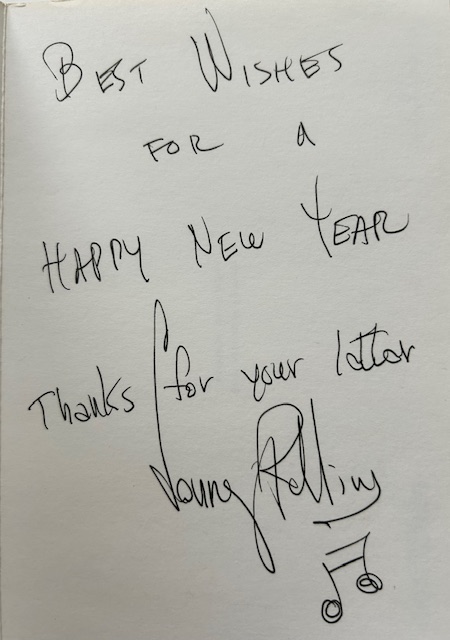
The card that Sonny Rollins sent me in response to receiving my letter written to him.

During those first voracious years of listening, so many things grabbed my attention. I learned how Charlie “Yardbird” Parker and his alto sax revolutionized jazz during the World War II years. In 1949-50 Parker recorded a double album full of standards backed by strings and the drum mastery of Buddy Rich as a kind of elevated platform for the genre and his own innovations. A decade later, tenor saxophonist Stan Getz picked up this torch and produced 1961’s Focus, featuring an amazing 8-minute improvisation of a certain Alice in Wonderland theme called “I’m Late, I’m Late” — with drummer Roy Hanes’s invigorating rhythms and a philharmonic string section. I followed my father’s advice and listened to the electric, bluesy magic of Cannonball Adderley’s “Mercy, Mercy, Mercy” from 1966 and later found a track I remembered from the radio when I was little: “Birdland,” an electric jazz-rock blend and an homage to a famous New York club named after Parker by the band Weather Report. The tracks on their album Heavy Weather became the soundtrack for science fiction books that I was reading that year including the novelization of 2001: A Space Odyssey and Niven and Pournelle’s futuristic page-turner Oath of Fealty.

In 2000 I couldn’t help but enjoy Ken Burns’s 18-hour documentary Jazz. He and his team provided a comprehensive and justified focus on the lifetimes of Duke Ellington and Louis Armstrong and an examination of the racial dynamics and injustices of U.S. history as they pertained to this art. Even so, Burns greatly truncated everything that happened after about 1961, which fed into the idea that the music stopped or died by the 1970s. The album that I kept thinking of that he left out was a 1975 Atlantic Records dual release called Changes One and Changes Two by the bassist and fiery bandleader named Charles Mingus. Maybe it was Mingus’s intense temperament that gave birth to Changes, in which he titled the first track “Remember Rockefeller at Attica” in a statement of political protest. If you give it a listen, that track is somehow both angry and artfully swinging. In “Sue’s Changes,” I found a recording that rewrote what music was capable of doing. I didn’t think music could be this attractive, revelatory, and off-putting all at once, but that composition, which was written about Mingus’s wife, mixes pure creativity with a fiery kind of journalism for a full 17 minutes. 

As I sat with the music and found the works that really moved me, I began to see the relationships that were at the heart of this music. Julian “Cannonball” Adderley and his brother Nat welcomed the Austrian-born Josef Zawinul to play piano and compose in their groups for 10 years of brilliant partnership and exploration. If you want to get a sense of how creative and catchy Zawinul could be (and how good of an ear Cannonball had), just listen to “Scotch and Water” by the quintet in 1961. This kind of union forged in the development of great jazz could be seen in cases such as Duke Ellington’s musical commitment to Billy Strayhorn as well as the interactions and expeditions of Miles Davis with Gil Evans. Like Adderley, John Birks “Dizzy” Gillespie found his own piano genius collaborator from abroad: the incomparable Lalo Schifrin, who hailed from Argentina. Schifrin would go on to create some of the most memorable original soundtracks, including those of T.V. series Mission Impossible and films Cool Hand Luke, Enter the Dragon, and jazz devotee Clint Eastwood’s Dirty Harry pictures among many others. Going back to the early 1960s and listening to Schifrin’s work with Diz underscores the paradoxical combination of showmanship and discipline found in jazz. In most of these pairings and so many others in the genre, ethnicity and nationality didn’t matter — or if they did matter, these elements enhanced through respect and investment the quality of the resulting repertoire. In 2008 Willie Nelson and jazz great Wynton Marsalis produced a collaboration in this same spirit of meeting on common ground called Two Men with the Blues. These instances of musical co-piloting remain one of the most powerful attractions of jazz for me. 

In 2003 I went to the Philadelphia Art Museum to see and hear the music of the maestro Kenny Barron and his trio. The sparse crowd was a bit of a disservice to the quality of the music, but it gave me the opportunity to sit right in the front row and take in the sound thoroughly. Kenny performed contemporary jazz standards such as James Williams’s “Alter Ego” and his own originals, and that concert completely raised the bar for me on how personal and beautiful music could be. After the concert, the thin crowd was once again a benefit as I had the chance to say hello to drummer Ben Riley, who had played in Rollins’s band back in (once again) 1961, appearing on the milestone recording The Bridge. Afterward, I even had the chance to introduce myself to Kenny and to convey a greeting from an old friend of his who was a coworker of mine. These small moments of connection, however brief, underscored for me the idea that although jazz had long ago become a path less traveled, the music spoke to me personally and maintained persistent relationships with almost every aspect of life.

Jazz lends itself quite well to the visual side of things, for example, so it’s appropriate that some of the most innovative film directors have used jazz in the manner of a key supporting cast member in their works. Otto Preminger enlisted Ellington to score the 1959 film Anatomy of a Murder. There is something so satisfying about watching Jimmy Stewart playing up his “old country lawyer” persona in the film as Duke’s distinctive band and arrangements set the mood and accompany the action. At one point, Jimmy Stewart sits down on the piano bench with Duke as he plays in a bar, and Stewart and the film’s creative team had to fight to keep the scene of a black man and a white man sitting together in the final cut of the film. The freedom and goodwill of the music aligned with the freedom from unjust social constraints. In a case of jazz and film cross-pollinating abroad, in the late 1950s the Frenchman Louis Malle was developing his debut dramatic film, Elevator to the Gallows. As a fan of the music of Miles Davis, Malle took advantage of Davis’s presence in France at the time to approach him about writing and performing the score. Malle established a truly collaborative partnership with Davis. The American became acquainted with the film’s story and then produced music organically that supported and accented the plot and characterization deftly. This artistic connection unmistakably contributed shortly thereafter to the approach and the craft of Miles’s 1959 LP Kind of Blue, the best-selling jazz album of all time.
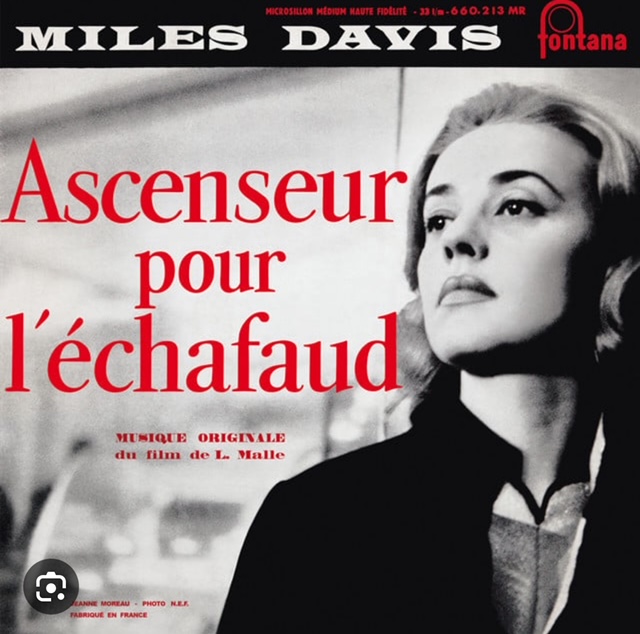
Cover of the French edition of the soundtrack to Elevator to the Gallows

Let’s go back to 1998 one more time (if only that were possible). That album by Sonny that I found was called Don’t Ask. It was recorded in 1979, and the key collaborator on this thing was a guitar player whom I’d never heard of before named Larry Coryell. I had grown up listening to the guitar pyrotechnics of my uncle Michael, but I would go on to learn that Coryell had played a key role in the path of this instrument, building on the seminal work of giants such as Les Paul, Charlie Christian, and Montgomery. In this pairing with Sonny, the track “Disco Monk” was one that I shared with anyone who would listen. People would listen and then simply stop and laugh as the piece’s radical shifts in tempo took them off-guard. The critics largely regarded it as a failure, but for me this track bridged the flamboyance of 70s dance music with the deep meditations in the monastery of melody and improvisation. I consider myself very grateful for whatever luck and synchronicity brought those two musicians and supporting cast together for that one-off recording. 

Finding new and inspiring music is always great fun, but jazz has continually provided me with old and inspiring music that was new for its time. Last year I had this kind of experience when I came across the Vince Guaraldi Trio’s recording Jazz Impressions of Black Orpheus from 1962. Guaraldi had been inspired by the movie referenced in the title, and he was one of the early takers on Bossa Nova — but with limited interest at the time from record labels. This moment was before his iconic piano stylings would become the soundtrack for the Charlie Brown and Peanuts TV specials. Guaraldi used this album as a bridge from cinematic and rhythmic inspiration to an unexpected place as he found a spot on the pop music charts with his 3-minute single “Cast Your Fate to the Wind.” Other moments on that same recording foreshadow Guaraldi’s sound as Schroeder’s piano on the Peanuts specials — as good of an illustration as one could find of jazz’s essential position in American culture. 

I know that the vast majority of people to whom I talk these days will never have heard of Sonny Rollins. That’s OK — we now live in times in which the canon is broader and more diverse and changeable than it ever was in 1960 or 1850, and music is not about checking boxes. It never was about that for Sonny, who turned 93 years old last September. Today, The main thing for me is that as Campbell said, I was caught by it. I found that same feeling of contented captivation in 2019 after we had just moved into the house on the street named for hope. I was building a rocket made of almost 2000 pieces, following the directions on every page. As I did so, my then 2-year-old daughter would steal a piece or use the spares to make something unpredictable of her own design. As we worked, or played, we listened to a 2018 disc called Flight by pianist James Francies from Houston, appropriately enough. The title track seemed to go well with the building of the spacecraft, and another one called “A N B,” gave me a feeling of floating in zero gravity. In this way, music has been the art with which I have lived the most, and across the globe, that is probably as close to universally true for folks as anything is.

So with that, if you hear the drums of Art Blakey, the reeds of Sonny Rollins, or the voice of Sarah Vaughn, and you enjoy some of those sounds, well — then that’s one of our connections.

C.S.

The Many Sounds of Jazz – Part 1

In 1998, I bought a used CD of a 1979 Sonny Rollins LP, and it became my doorway to being a lover of the music called jazz. My father once commented that I wasn’t supposed to like jazz—and the wonder of this comment was that it was a compliment. He meant that he was surprised and impressed that someone who grew up with and loved pop music and couldn’t read or play music would become a devoted listener and collector of jazz. Here is a list of jazz recordings that have moved me considerably with some short notes on why. Some hard-to-categorize albums are included because of their kinship with jazz in terms of design and creativity. Albums are in no particular order. Both orchestral jazz and later developments in the music will be included in Part 2. Most of the selections are LP’s and original CD’s, but there are rare instances of multi-album sets.

1st Set – Jazz Modern and Classic:      

1. Moanin’ (1958, Blue Note) – Art Blakey and the Jazz Messengers

If you like your jazz in the form of the blues, this is a perfect album. It is a standard jazz quintet (piano, bass, and drums plus trumpet and tenor saxophone) manned by geniuses at every position. I recently shared this album with a guy who was a big fan of Stevie Wonder, Yes, and prog rock in general. After he listened to it, he said, “Wow, great music—where can I get more like it?” My reply was that it was a little bit like asking where you can get more of Abbey Road by the Beatles. Along with Art’s vibrant drumming style, the brilliance of this album emerges in the original compositions by pianist Bobby Timmons and the band’s then musical director and tenor saxophonist Benny Golson. On the piano, Timmons plays dense, almost gothic-sounding blues chords in his solos while Golson’s melodies and structures constantly surprise and excite. The Philadelphia-born Lee Morgan at the young age of 20 here, supplies some of the most spine-tingling and riveting trumpet solos I’ve ever heard. Ready for great music? Give Moanin’ a listen. It’s incredibly rich and original.


2. Live at the Pershing: But Not for Me (1958, Chess) – Ahmad Jamal

Over the course of his sixty-plus year (and still going) career, Jamal has consistently gravitated to the classic trio format, and his command of the piano is second to none. This album is a superb illustration of pitch-perfect wittiness, invention and stellar rhythm delivered live at the Pershing Club in Chicago. The eight-minute rendition of Poinciana on this record was edited and successfully charted as an R&B hit—and with good reason. Jamal’s performance of the closing track, “What’s New,” is reflective and surprisingly ominous in the final bars. The keynote achievement of this music is that it is innovative but very accessible.


3. Sonny Side Up (1957, Verve) – John Birks “Dizzy” Gillespie with Sonny Stitt & Sonny Rollins

This album is a knockout presentation of the vibrancy and musicality that is possible when great jazz musicians get together. Dizzy provides a vocal on the opening tune and then his trumpet and the dueling tenor saxophones of the two Sonnies get all fired up from there. The Eternal Triangle is a 14-minute high energy jazz battle between Stitt and Rollins. After Hours is the greatest blues I’ve ever heard – Ray Bryant’s extended piano intro really sets things up and then Diz can be heard on the perimeter verbally stoking and tweaking his two saxophonists as these two champions heat things up. This is beautiful, proud Black American music of a perfect vintage and superb craftsmanship.


4. Concert by the Sea (1955, Columbia) – Erroll Garner

Erroll Garner is best known as the author of the jazz standard “Misty,” and this live concert recorded in Carmel, California is one of his most dynamic and complete recordings. The opener, “I’ll Remember April,” is quite simply a staggering display of piano wizardry. On the keys, Garner uses trills, staccato riffs, light twinklings, and then produces expansive, driving sections that sweep the listeners into his world. The audio on this recording is not very good, and Erroll’s famous background humming and vocalizing can be heard throughout the album—hilarious in its own way and somehow unmistakably authentic. The trio’s rendition of the standard “Autumn Leaves” is particularly rich in melody, pomp and sentiment. Like Duke Ellington, Erroll Garner was one of those uncommon musical talents who also comes across as being very centered, joyful, and lacking in egotism—and this comes through in the spontaneous one-liner that ends the album. Pure Brilliance.


5. Mosaic (1961, Blue Note) – Art Blakey and the Jazz Messengers

This version of the Jazz Messengers is a sextet that retains only drummer Blakey and bassist Jymie Merritt from the earlier Moanin’ session. This recording introduces the piano of Cedar Walton, the tenor saxophone of Wayne Shorter, the trombone of Curtis Fuller, and the trumpet of one Freddie Hubbard. All of the compositions are new ones contributed by the group members, and the tunes have a searching, intense quality to them. The most beautiful might be Wayne Shorter’s “Children of the Night,” but all of them resonate. Art unleashes a galvanizing drum solo on the title track, and Jymie Merritt’s bass hums perfectly on Freddie Hubbard’s closer “Crisis”—which appropriately sounds like something emergent is happening. As it turned out that was quite true; these new messengers and their communications had unmistakably arrived.


6. The Cannonball Adderley Quintet Plus (1961, Riverside)

There’s something of a soul music crossover here on this album along with its genuine straight-ahead jazz pedigree. After all, when you cover Thelonious Monk’s “Well, You Needn’t” and the Charlie Parker associated “Star Eyes” this well, you are firmly in jazz territory. But there’s something else going on too. Cannon’s alto sax solos are fluid and gorgeous as can be, but the vibraphones of Victor Feldman give the music an ethereal quality that complements the night-time, street scene imagery conjured by these tunes. Feldman’s brilliant tune “Lisa” is perfectly designed and expertly played by the group—check and mate. How did that one not become a giant hit and a jazz standard? The opener “Arriving Soon” is also quite a scene-setter, and the whole session is a gem of the post-bop era.


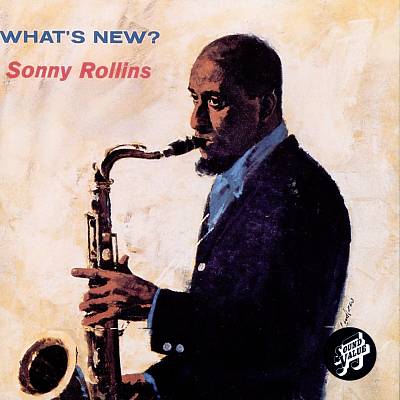
7. What’s New (1962, Bluebird/RCA) – Sonny Rollins

Sonny Rollins What's New

While Saxophone Colossus and The Bridge are often at the top of many lists of great jazz recordings and/or superior Rollins recordings (and rightfully so), I want to call attention to this one because of Sonny’s melodic improvisation in the context of island rhythms and Brazilian stylings. Three of the album’s five tracks feature Jim Hall’s electric guitar, and his brilliance as both a soloist and an accompanist is on full display in the Bossa Nova-oriented tunes. On “Jungoso” and “Bluesongo” Sonny performs in primal duets with percussionist Candido on congas. Sonny’s tenor saxophone sounds authoritative and endlessly creative, and this piano-less group answers the album title’s question with great skill and spirit.


8. Kind of Blue (1959, Columbia) – Miles Davis

Miles Davis is a fairly provocative figure in terms of his personality and history. Putting that aside for a moment, this recording is the best-selling jazz album of all time with good reason. Miles’s compositions are timeless, and the group is positively top-notch. John Coltrane is full of ideas on “All Blues,” and Cannonball Adderley plays with gorgeous lyricism on both takes of “Flamenco Sketches.” Bill Evans and Wynton Kelly shine on piano, while Jimmy Cobb and Paul Chambers anchor the flawless rhythm section. It would be disingenuous not to include this in any list of highly listenable jazz recordings.


9. Duke Ellington Meets Coleman Hawkins (1962, Impulse)

Two all-time jazz masters play (for the first and only time) in an octet grouping culled from Duke’s orchestra. Hawkins’s tenor saxophone has its characteristic deep, rich sound, and he sounds perfect on this set of Ellington originals. One of the highlights is the “Self-Portrait of the Bean,” which was written especially as a vehicle for Hawk. Ray Nance switches over to violin to great effect for a few tunes, and this includes the beautiful, almost hypnotic rendition of Ellington’s “Solitude.”


10. The Incredible Jazz Guitar of Wes Montgomery (1960, Riverside)

With Tommy Flanagan at the piano in this quartet, Wes Montgomery presents a superior set of takes on a mix of standards and his own originals. This album is one of the most accessible on my list. “Polka Dots and Moonbeams” is very pretty and gentle while “D-Natural Blues” lives right up to its name—perfectly poised, melodic and at home in the idiom. “Mr. Walker” might be my favorite track with its sense of mid-tempo drive and attitude. This is a superb look at authentic jazz in the small group outing that published Wes’s greatness on the electric guitar. He would become known as “The Thumb”!


2nd Set – Voices in Jazz

11. Ella Fitzgerald In Budapest (Recorded in 1970, Pablo)

This live concert recording was not released until 1999, and as a fan of Ella’s singing beyond the bebop years, I find this to be my favorite album of hers. Tommy Flanagan plays piano, and Ella provides her uniquely energetic interpretations of the songs of Duke Ellington, Burt Bacharach and even Blood, Sweat & Tears. She has such a strong sense of humor and presence along with her vocal gifts, and we are lucky to have this great road show documenting her in peak form.


12. Sassy Swings the Tivoli (1963, Mercury) – Sarah Vaughan

This gold standard recording was created at the Tivoli Garden in Copenhagen, Denmark. It is a double-album (now a double CD) that was produced by the famous Quincy Jones, and it’s loaded with emotion, poise, and rich vocal artistry. Sarah sings a wealth of standards, including memorable renditions of songs from West Side Story and more overtly jazz-oriented material such as “Lover Man.” In the song “Misty,” pianist Kirk Stuart sings a duet with Vaughan in what turns out to be a sensitive yet almost vaudevillian performance in its showmanship. A great recording, just before the ‘60s became the turbulent decade we now remember it to be.


13. The Hottest New Group in Jazz (Recorded 1960-1962, Columbia) – Lambert, Hendricks, and Ross

Vocalese is the art of creating lyrics and vocals based on original jazz compositions and solos. This innovation went beyond mere scat-singing to honor great instrumentalists and explore new angles and layers in classic works of jazz. One of the best early practitioners of vocalese was the awesomely stage-named King Pleasure, and there was also the amazing Eddie Jefferson, who wrote lyrics to Coleman Hawkins’s famous improvisation of the standard “Body and Soul.” This group Lambert, Hendricks, and Ross are vocalese musicians who brought this technique into a feature presentation mode. This Hottest New Group CD is actually a compilation of 3 complete albums titled after their first one for Columbia. Jon Hendricks and his cohorts are in particularly superb form in their takes on the Ellington songbook. Annie Ross is hilariously cheeky on “Rocks in My Bed,” and the whole group shines on “Main Stem.” On “What Am I Here for?” the group waxes with humor and philosophical depth in a compact three minutes. This is frenetic, but well-coordinated vocalization built on decades of classic jazz.


14. Wild is the Wind (1965, Philips) – Nina Simone [reissued in a two-album CD w/ High Priestess of Soul]

Nina Wild as the Wind

From the spare beauty of the album cover to the unusual and striking set of songs herein, This Wild is a remarkable set. The title track is a ferociously romantic portrait as it is sung by Simone, and her original “Four Women” is one of the most haunting and socially conscious African-American ballads since Billie Holiday’s phenomenal “Strange Fruit.” Some of these tunes have a pop-symphonic structure while others are squarely in the jazz genre, but there’s no point to being a purist when Nina Simone is singing—whatever she wants to sing is OK with me.


15. Bop for Miles (Recorded 1990 & 1999, High Note) – Mark Murphy

On Ralph Gleason’s Jazz Casual television program in the 1960s, Mel Torme once said of Mark Murphy, “I think he’s an interesting singer, but I don’t think he’s a jazz singer.” Fifty years later, I would submit that he is both interesting AND an accomplished jazz singer. Murphy loves to scat, writes very canny lyrics, and possesses a rich vocal timbre. He also has a gift for infusing poetic storytelling and spoken word into his performances. On this tribute to Miles Davis, Murphy concludes the album with a heartfelt original song for the great trumpeter. The highlight for me is the up-tempo take of “Autumn Leaves” with an unbelievably beautiful and riveting piano solo by Peter Mihelich. An uncommon recording and a worthy tribute to Davis.


16. The Great Summit (Recorded 1961, Roulette) – Louis Armstrong & Duke Ellington

The 17 songs that comprise these recordings paired the piano and written repertoire of the great Duke Ellington with Jazz’s one-man orchestra Louis Armstrong. The backing band is primarily Satchmo’s band members of the time, and they tackle the classics of the Ellington songbook with poise and humor. Apparently Duke Ellington also wrote “The Beautiful American” and the closing tune “Azalea” especially for this session, and Louis gives them all the care that these brilliant originals merit. A great album to hear Louis and a delightful glimpse at Ellington playing piano in a smaller than usual grouping for him.


17. Getz/Gilberto (1963, Verve) – Stan Getz & Joao Gilberto with Antonio Carlos Jobim

This recording is best known for “The Girl from Ipanema” with Astrud Gilberto’s vocal, but there is a lot of great music here along with that iconic single. Every track is rich in melody, and “Corcovado” in particular is truly arresting in its beauty. The acoustics and arrangements sound crystal clear as usual on Verve’s Master Edition reissue of the album, and its capture of the Best Album Grammy award for 1964 is completely justified.


18. Two Men with the Blues (2008, Blue Note/Angel) – Wynton Marsalis & Willie Nelson

These two men speak the language of music, and they are very much at home in the same dialect on this legitimately bluesy and swinging set of takes. Some tracks are recorded live, and all of them sound naturally and instinctively executed. Willie takes the majority of vocals, but Wynton chimes in on the hilarious “My Bucket’s Got a Hole in It.” Many classics are given stellar treatment here, including a poetic “Stardust” and a  reading of “Down by the Riverside.” The one tune that makes me wince a bit at the lyrical content is “Ain’t nobody’s business” with its self-centered misogyny, but in some ways it’s a logical fit in a collaboration that is certainly no white-wash of musical history.


19. Encounter (1976, Milestone) – Flora Purim

Joining with fantastic instrumentalists like sax wizard Joe Henderson and pianist McCoy Tyner, the adventurous jazz-fusion singer Flora Purim delivers a diverse set of brilliant tracks here. Chick Corea’s “Windows” is given a superb reading as the opener, and from there the set alternates between energetic wordless vocals and gently put lyrics by Flora. An unusual collection of songs delivered by expert musicians.


20. John Coltrane and Johnny Hartman (1963, Impulse)

This recording is one of my absolute favorite Coltrane recordings because of the consideration that he shows while in no way limiting the creativity and sincerity of his approach on the tenor saxophone. Johnny Hartman has a very rich, old-fashioned sounding voice that is perfectly suited to the classic tunes interpreted here. The Coltrane quartet is in exquisite form, and you can really hear Jimmy Garrison’s bass humming gracefully and propelling things along. “Autumn Serenade” and Billy Strayhorn’s “Lush Life” really come together on this standout vocal/instrumental session.